
Understanding demand & supply turns impulsive trades into planned actions. Have you ever taken a breakout trade — felt confident — and then watched price reverse instantly and hit your stop-loss?
Most traders look at indicators first. However, professional traders study imbalance before anything else. That perspective separates novice errors from professional accuracy. They focus on one key question: Which side controls the market currently? When you understand that, trading feels clearer and calmer.
In This Guide, You’ll Learn:
- What demand & supply really mean
- How to identify high-quality zones
- How professionals score zones
- Risk management rules
- Real trade example breakdown
We’ll explain this in a clear and actionable manner.
Table of Contents
What Demand & Supply Actually Indicate
At its core, trading is an auction.
- Demand = buyers want the asset.
- Supply = sellers want to exit the asset.
When demand is higher, price rises. When supply is higher, price falls. That’s it.
Think about a hot IPO. Everyone wants it. Price shoots up. Now think about panic during a crash. Sellers rush out. Price drops fast. That’s Demand & Supply dynamics in action.
You already see this in daily life. If mangoes are scarce, price rises. If they flood the market, price drops. The stock market works the same way.
Even tools like Market Depth reflect this ongoing battle between buyers and sellers.
Also Read: ChatGPT vs. Google in Trading
Why Demand & Supply Outweigh Traditional Indicators
Indicators react to price. It uncovers the cause behind each market move.
For example, RSI: How to Make This Indicator Work for You may show overbought. But why is it overbought? Because demand dominated earlier.
Likewise, a Golden Crossover performs better when backed by genuine buying strength.
When you understand imbalance You:
- Avoid False Breakouts
- Find High Probability Trades
- Improve your Entry and Exit Points
In fact, most successful traders combine price action with imbalance. That’s also part of the Smart Money Concept: Ways to Build Wealth That Lasts.
Also Read: Trading Psychology
Locating Demand & Supply Zones Clearly on Price Charts
Now let’s get practical.
A strong zone usually has three parts:
- Impulse move – sharp rise or fall
- Base – small pause or consolidation
- Departure – aggressive breakout
You mark the base area. That’s where big players likely placed orders.
Not every zone is worth trading. Institutional-level traders score zones before taking a position.
Use this checklist:
Also Read: Famous Stock Market Terms
Zone Quality Checklist (Score out of 10)
Also Read: Technical Analysis
Zone Freshness Rule:
- First retest → Highest probability (Institutional orders still pending)
- Second retest → Probability decreases significantly
- Third retest → Avoid trading unless strong confirmation exists
Each retest absorbs remaining institutional liquidity. Fresh zones are always stronger than recycled zones.
Score Guide:
- 8–10 → A+ High-Probability Zone
- 6–7 → Tradable with confirmation
- Below 6 → Avoid
This filtering process instantly increases trading precision.
According to multiple backtested price action models, fresh imbalance zones statistically show higher reaction probability than recycled levels.
Volume Confirmation – The Hidden Strength Filter
Price shows movement. Volume shows commitment.
A strong demand or supply zone is far more reliable when the departure happens with volume expansion.
Here’s how to use volume correctly:
- Strong departure + high volume spike = Institutional participation
- Strong departure + low volume = Weak conviction
- Rising volume during breakout from base = Real imbalance
- Falling volume inside base = Healthy consolidation
Professional insight:
If price leaves a zone aggressively but volume is average or declining, the move may lack institutional order flow.
High-quality zones often show:
- Volume expansion during impulse
- Low volume during base
- Volume surge on breakout
Volume confirms whether imbalance was created by retail noise or institutional activity.
Also Read: Positional Trading
Demand Zone (Buy Area)
Look for:
When price returns, buyers may step in again.
This works well with patterns like Double Bottom: How to Spot a Hidden Goldmine Now or Morning and Evening Star setups.
Also Read: How to Open a New Trading Account
Supply Zone (Sell Area)
Look for:
- Strong bearish candle
- Tight consolidation
- Sharp drop afterward
When price revisits, sellers may dominate again. You’ll often see this near a Double Top or after a Market Gap upward exhaustion.
Keep it simple. Clean charts outperform clutter.
Also Read: Backtesting & Forward Testing
When a Supply & Demand Zones Fail
A zone weakens when:
- Price has already tested it 2–3 times
- A strong opposite Break of Structure (BOS) has occurred
- Price consolidates deeply inside the zone
- It goes against the higher timeframe trend
- The original departure lacked real imbalance
Golden Rule:
Repeated retests reduce institutional order strength.
Structured traders prioritize fresh, untested zones.
Full Invalidation Rule:
If price closes strongly beyond the distal line with a clear Break of Structure and volume expansion, the zone is considered invalid.
Once invalidated, do not trade the zone again.
Shift bias and look for continuation setups instead.
Also Read: Trading Tick
Also Read: Colour Trading
Demand & Supply vs Support and Resistance
They may appear alike, yet they function differently. Support and resistance focus on visible reactions. It explains why price reacted sharply from specific levels.
Support says: “Price reacted here.”
This concept says: “Big money created imbalance here.”
That’s why many traders combine it with Order Block Trading, Liquidity Concept, or Trendline Power for confluence.
When zones align with tools like Fibonacci Retracement, probability improves.
This is your Confluence Edge in action.
Also Read: Nifty & Sensex
Using Multiple Timeframes for Better Results
You never trade in isolation.
Use a multi-timeframe (MTF) approach:
For example:
Now you have alignment.
This method improves Intraday Trading Skills and also supports Positional Trading decisions.
It also helps you understand Market Cycle: How to Make it Work for You.
Also Read: Options Trading
How to Define Higher Timeframe Bias Clearly
Higher timeframe bias tells you who controls the market.
Without bias, zones are random.
With bias, zones become directional weapons.
Follow this 3-step framework:
1️⃣ Identify Trend Structure on HTF (Daily / 4H)
- Rising highs and rising lows indicate bullish momentum
- Falling highs and falling lows suggest bearish pressure
2️⃣ Mark Major HTF Demand & Supply Zones
Only trade zones aligned with HTF direction.
3️⃣ Check HTF Imbalance Strength
- Strong impulsive move?
- Clean Break of Structure?
- Volume expansion?
Professional Rule:
If Daily bias is bullish → prioritize Demand Zones only.
If Daily bias is bearish → prioritize Supply Zones only.
Counter-trend zone trades require stronger confirmation and offer lower probability.
Bias gives direction. Zone gives location. Structure gives confirmation. Risk management ensures survival.
That’s professional alignment.
Proprietary trading firms use similar imbalance-based frameworks.
Also Read: Moving Averages
Professional Entry Models
Never enter just because price touches a zone. Use confirmation models.
Model 1: Zone + Engulfing Candle
Zone touch followed by a strong engulfing candle = entry trigger.
Model 2: HTF Zone + LTF Structure Break
Higher timeframe zone → Lower timeframe break of structure → Entry.
Model 3: Liquidity Sweep + Rejection
Equal highs/lows swept → Strong rejection candle → Entry.
Mechanical execution reduces emotional interference and increases statistical consistency.
This approach strengthens your Price Action Strategy and aligns with Smart Money Trading Strategy principles.
This demand and supply trading strategy works best when combined with structure and liquidity analysis
Also Read: Hedging
Understanding Market Structure Shift and Break of Structure
Zones work best when structure confirms them.
Break of Structure (BOS):
When price surpasses a prior high or drops below a prior low.
Market Structure Shift (MSS):
When the trend direction changes.
Example:
Uptrend = Higher Highs + Higher Lows
Breaking a prior higher low may indicate emerging bearish strength.
Professional execution rule:
HTF demand zone + LTF bullish structure break = High probability buy
HTF supply zone + LTF bearish structure break = High probability sell
Without structure confirmation, zone trades become random.
Structure gives context. Zones give location.
Also Read: Short Selling Mistakes
Liquidity, Stop Hunts & Smart Money Logic
The market does not move randomly. Before a real move begins, price often grabs liquidity.
Common liquidity areas:
- Equal highs
- Equal lows
- Previous swing highs/lows
- Trendline clusters
What smart money does:
- Triggers retail stop losses
- Executes liquidity sweeps
- Then pushes price in the real direction
That’s why price may temporarily break above supply or below demand.
This pattern is called:
Liquidity Sweep + Zone Reaction = High-Probability Setup
Price imbalance occurs when aggressive buying or selling creates inefficiency, leaving unfilled orders behind.
These inefficiencies create liquidity zones — areas price often revisits before continuing.
Smart money returns to rebalance unfilled orders before the next expansion.
Also Read: Sector Rotation
Also Read: Fundamental Analysis
Institutional Buying Absorption & Imbalance Creation
Not all strong candles are equal. Institutional traders rarely enter with a single candle. Instead, they accumulate positions inside the base. That accumulation reflects true institutional order flow.
Retail traders react to price. Institutions create price imbalance through large order execution.
Understanding institutional order flow helps you trade alongside smart money instead of against it.
Order absorption happens when:
- Large buy orders absorb selling pressure
- Large sell orders absorb buying pressure
This creates:
- Tight consolidation
- Reduced volatility before expansion
- Sudden aggressive breakout
Why departure matters:
Strong departure = Unfilled institutional orders remain
That is why price often returns to that zone. If departure is weak and overlapping, it signals no true imbalance.
Institutional footprint = Strong imbalance + Volume expansion + Clean structure break.
That’s what separates retail reaction from professional positioning.
Also Read: Market Capitalization
Risk Management with Demand & Supply
A zone provides probability, not certainty.
So you manage risk.
Place stop-loss:
- Below demand zone
- Above supply zone
Then calculate your Risk to Reward Ratio. Aim for at least 1:2.
This connects directly to Risk Management Guide for New and Fearless Investors.
Also remember:
- Avoid Revenge Trading
- Control Trading Fear
- Maintain Trading Consistency
Trading without discipline leads to the same outcome described in 10 Trading Mistakes That Really Destroy Your Success Quickly.
You don’t need complex formulas. Sometimes it’s simply about learning How to Make Trading Easy: Manage Risk Without Formulas.
Also Read: How to Choose the Right Trading Style
Also Read: Nifty Expiry
Position Sizing Example (Real Calculation)
Example:
- Account Size = ₹100,000
- Risk Per Trade = 1%
- Risk Amount = ₹1,000
If zone distance to stop-loss = 50 points:
Position Size Formula:
Risk Amount ÷ Stop Distance
= 1000 ÷ 50
= 20 units
Your position size becomes 20 units.
Stop-loss should always be placed slightly beyond the distal line.
Professional standard:
- Minimum R:R = 1:2
- Ideal R:R = 1:3 or higher
Win rate matters less than risk-reward asymmetry over time.
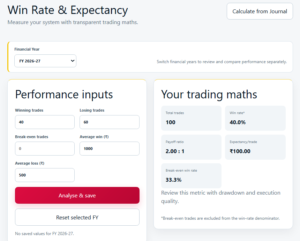
Even a 40% win rate becomes profitable with consistent 1:3 risk-reward execution. Consistency, not prediction accuracy, builds equity curves.
Also Read: How to Shield Your Trading Account
Where Demand & Supply Works Best
The advantage is that it works across all markets. Its strength lies in applicability across different markets.
- Stocks (BSE and NSE Simplified)
- Futures Trading Success
- Options (Strike Price selection)
- Crypto
- Commodities
Even ETFs like NiftyBees follow the same imbalance principles.
During a Bull Market Surge, demand zones hold well.
During market crashes, supply zones dominate. That’s how disciplined traders position for downside continuation.
Understanding imbalance also improves:
- Breakout Opportunities
- Momentum Edge
- Triangle Chart Pattern
- Heikin Ashi Candle
- Bollinger Band
Everything ultimately connects back to buyer-seller imbalance.
Also Read: Pledge
Combining it with Structured Risk Control
Don’t risk money blindly.
Start with:
Use platforms like TradingView to mark zones clearly. Keep a Trading Journal. Write why you entered. Write what happened. This routine strengthens discipline and limits expensive errors. Secure your trading and Demat accounts prior to entering markets.
Build step by step, don’t rush.
Also Read: Chart Pattern
Also Read: Gift Nifty
Circumstances That Reduce Demand & Supply Effectiveness
Disciplined traders make money by avoiding low-quality setups.
If your setup does not meet at least 3 confluences (Zone + Structure + Liquidity or Volume), do not execute.
Selective trading builds equity.
Overtrading benefits your broker — not your equity curve.
Sometimes avoiding a trade is the smartest decision.
Do NOT trade when:
- Zone has been tested multiple times
- Price is stuck in mid-range with no imbalance
- Higher timeframe trend conflicts with setup
- Volume is extremely low (dead sessions)
- Major news event is approaching
- Zone departure was weak and overlapping
- Market is in choppy sideways structure
- You feel emotional pressure to trade
Remember:
Selective execution protects capital.
Overtrading destroys it.
Experts profit mainly in clear conditions, not nonstop trading.
Also Read: Dividend Stocks
Common Mistakes You Should Avoid
Many traders struggle because they:
- Draw too many zones
- Trade against momentum
- Skip risk planning
- Trade already tested zones
- Ignore higher timeframe bias
- Enter mid-range without structure
- Trade during low-volume sessions
- FOMO on first touch
- Enter before confirmation
- Overconfidence after a winning streak
Experienced traders are selective, not reactive.
Also, avoid trading only on hype or Trading On News without structure.
Patience matters. That’s why learning to be Patient in Trading changes everything.
Remember, even the best strategy fails without discipline.
Follow clear Trading Rules. Stay consistent. Stay calm.
Also Read: Trading Account Setup
Also Read: Nifty Reversal
Complete Trade Walkthrough Example
Theory builds understanding. Execution builds confidence. Let’s now see how everything comes together in a real structured trade.
1: Daily chart shows a strong demand zone
2: Price pulls back into the zone
3: 1H chart shows a liquidity sweep
4: Bullish engulfing candle forms
5: Entry at 150
Stop-loss: 145
Target: 165
Risk = 5 points
Reward = 15 points
R:R = 1:3
Outcome:
Price respected the demand zone, formed continuation structure, and hit full Take Profit at 165.
This is what structured execution looks like.
If price had closed below 145 with strong volume, trade would be invalid and stop-loss accepted without emotional reaction.
Professionals accept losses.
They don’t fight structure.
They protect capital first. Profit comes second.
Structured execution is what produces consistent growth.
Also Read: Trend Reversal
Why This Zone Scored 10/10 (A+ Grade)
- Impulse Strength → Strong bullish candle with wide range (2/2)
- Base Structure → Only 2 small candles before breakout (2/2)
- Clean Departure → No overlapping wicks, sharp imbalance (2/2)
- Freshness → First retest after creation (2/2)
- Daily bullish structure gains full strength with higher timeframe alignment (2/2)
Total Score = 10/10 (A+ Grade).
This is why the trade had high probability.
Consistent traders do not trade every zone.
They trade high-scoring zones only.
Also Read: Circuit Limit
The Strongest Advantage
The market does not reward prediction. It rewards positioning. It’s about responding to price flow, not guessing outcomes. You are waiting for price to return to imbalance. Professionals think in probabilities. Amateurs chase certainty.
True mastery means aligning with imbalance, not forecasting price.
Also Read: How to Use Stock Heatmaps
FAQs about Demand & Supply
Is Demand & Supply good for beginners?
Yes, it simplifies trading by emphasizing imbalance over delayed signals. New traders grasp imbalance faster than complicated calculations.
Does Demand & Supply work in intraday trading?
Absolutely. It works well with Intraday Trading Skills, especially when combined with trend analysis.
Also Read: Gift Nifty
How do I confirm a strong zone?
Look for sharp moves, low time spent in the base, and strong volume. Confluence with trend helps. Extra advice: confirm higher timeframe zones to boost conviction.
Does combining it with indicators improve results?
Yes. Indicators such as RSI, Bollinger Bands, Fibonacci, or order types can enhance analysis.
Also Read: Trading Failure
Final Thoughts
A solid grasp replaces feelings with structured decisions. You begin recognizing the reasoning behind each price action. Price isn’t emotional — it reacts to imbalance. Your job is simple: align with it and don’t fight it.
So slow down. Mark clean zones. Wait for price to come to you.
Because in trading, patience compounds. Prediction exhausts. And once you master this concept, you stop chasing price — and start letting price come to you.
If you want to build a complete trading framework, explore related strategies like Smart Money Trading Strategy, Liquidity Grab Strategy, and Risk Management Strategy for Beginners.
Master this concept, and you stop reacting to price — you start anticipating structure.
If this guide improved your clarity, bookmark it before your next trade.
Also Read: Market Order & Limit Order