A chart can look attractive and still be a poor trade. The broader market may be weak, the sector may be underperforming, the stock may be illiquid, or the stop-loss may require more risk than your account can reasonably take.
This guide turns that sequence into a repeatable beginner-friendly process. It does not predict whether a trade will win. It helps you decide whether the idea is defined well enough to take at all.
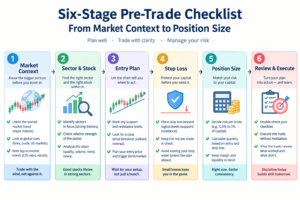
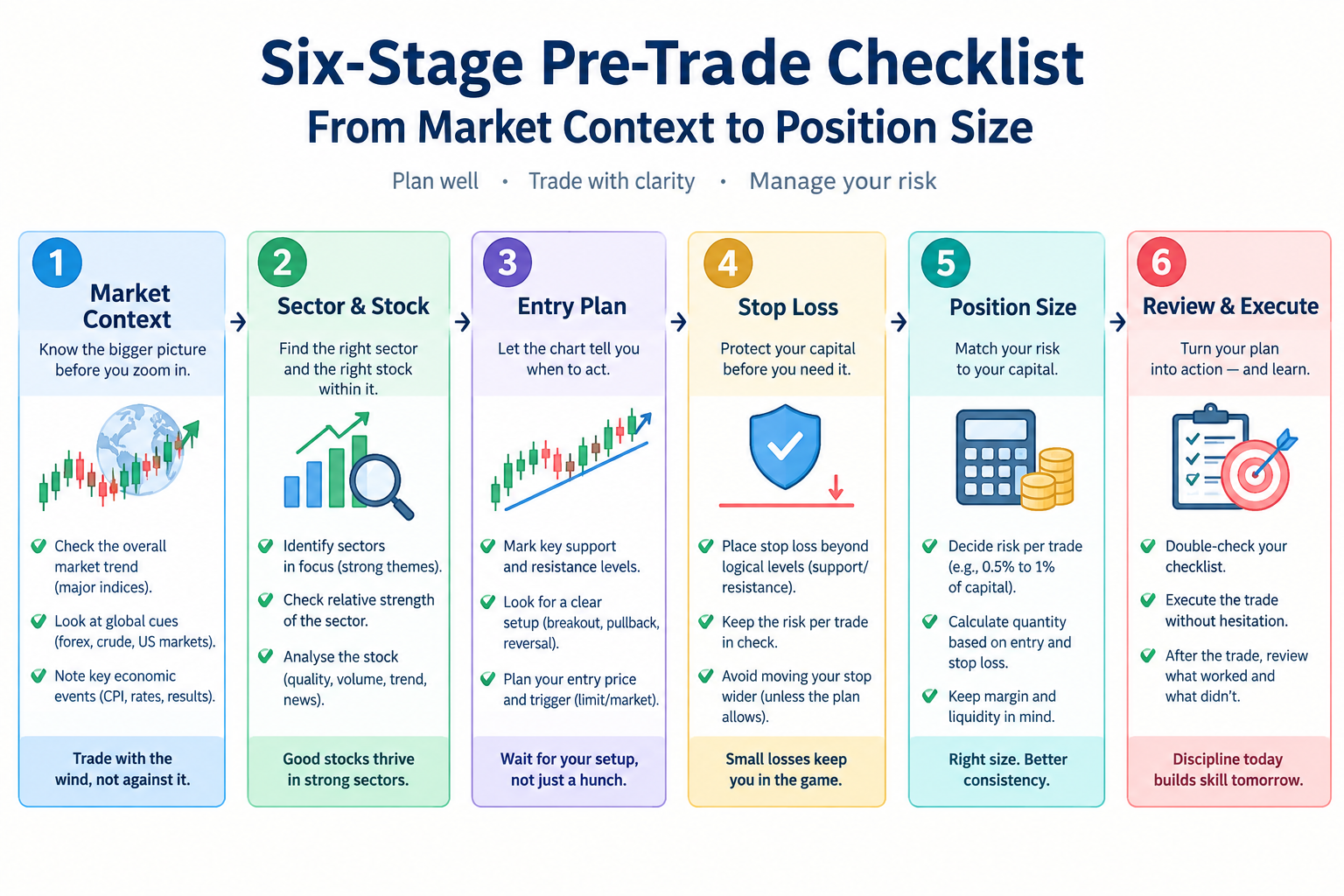
Before placing a trade, check six things in order: the market, the sector, the stock, the entry trigger, the stop-loss and the position size. Reject the trade when the entry or invalidation is unclear, liquidity is inadequate, or the calculated quantity exceeds your risk or capital limit.
Table of Contents
Author Observation: When I was starting out, I often got interested in a stock before checking everything around the trade. I’d spot a setup, decide where I wanted to enter, and then work out the stop and quantity afterward. A few times, I also ignored what the broader market was doing because the stock chart looked clean to me. I remember feeling confident about the setup at first, then hesitating once the market started moving against it. Looking back, I was checking the stock, but not really checking the trade.
Quick Pre-Trade Checklist
| Stage | Question | Possible status |
|---|---|---|
| Market | Is the broader market supportive, mixed or clearly hostile to the setup? | Pass / Caution / Reject |
| Sector | Is the relevant sector confirming or contradicting the stock idea? | Pass / Caution / Reject |
| Stock | Is the stock liquid, tradable and technically suitable for the setup? | Pass / Caution / Reject |
| Entry | What exact observable event triggers the trade? | Pass / Reject |
| Stop | What price or condition invalidates the trade idea? | Pass / Reject |
| Size | How many shares fit both the risk limit and available capital? | Pass / Reject |
A Reject on Entry, Stop or Size normally means no trade. A Caution is not permission to ignore risk; it means the trader must define how the condition changes the plan.
What Is a Pre-Trade Checklist?
A pre-trade checklist is a written decision process completed before an order is placed. It confirms that market context, security selection, entry trigger, invalidation point and position size are defined in advance. Its purpose is consistency and risk control—not predicting the next price move or guaranteeing a profitable trade.
The checklist should be short enough to use on every trade but specific enough to prevent impulsive exceptions. A completed checklist also creates a record that can later be compared with the actual result in a trading journal.
1. Market: Is the Broader Market Supporting the Setup?
The market check asks whether the broader index and current trading conditions support, weaken or invalidate the planned setup. For an Indian equity trade, a beginner may observe a relevant broad index, price structure, volatility, gaps and major scheduled events. Market direction alone should not be treated as a buy or sell signal.
What to observe
- The direction and structure of a relevant broad-market index.
- Whether the market is trending, range-bound or unusually volatile.
- Large opening gaps and whether the planned entry would require chasing.
- Major scheduled events that could change volatility.
- Whether your setup has historically been defined for this type of condition.
Market decision
| Status | Meaning |
|---|---|
| Pass | The market condition is compatible with the written setup. |
| Caution | Conditions are mixed; reduce assumptions and apply the predefined rule. |
| Reject | The setup is not designed for the present condition or the risk cannot be defined. |
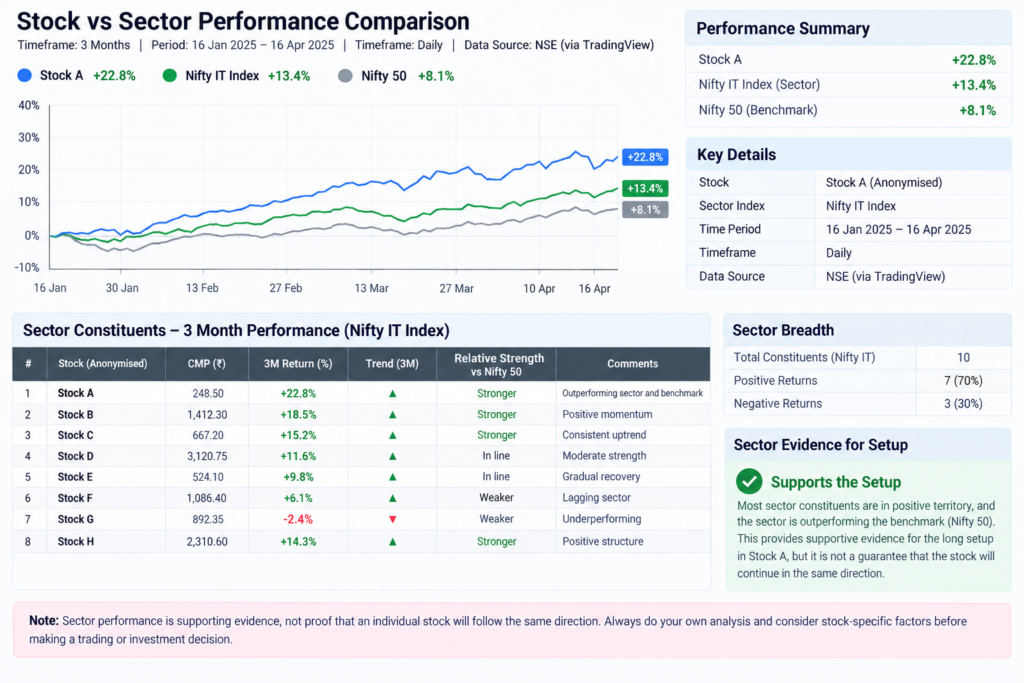
2. Sector: Is the Stock Moving With or Against Its Group?
The sector check compares the stock with its relevant industry or sector benchmark. Sector confirmation can strengthen the context of a stock setup, while clear sector weakness may create a caution or rejection. Sector performance is supporting evidence, not proof that an individual stock will follow the same direction.
3. Stock: Is the Security Suitable for the Planned Trade?
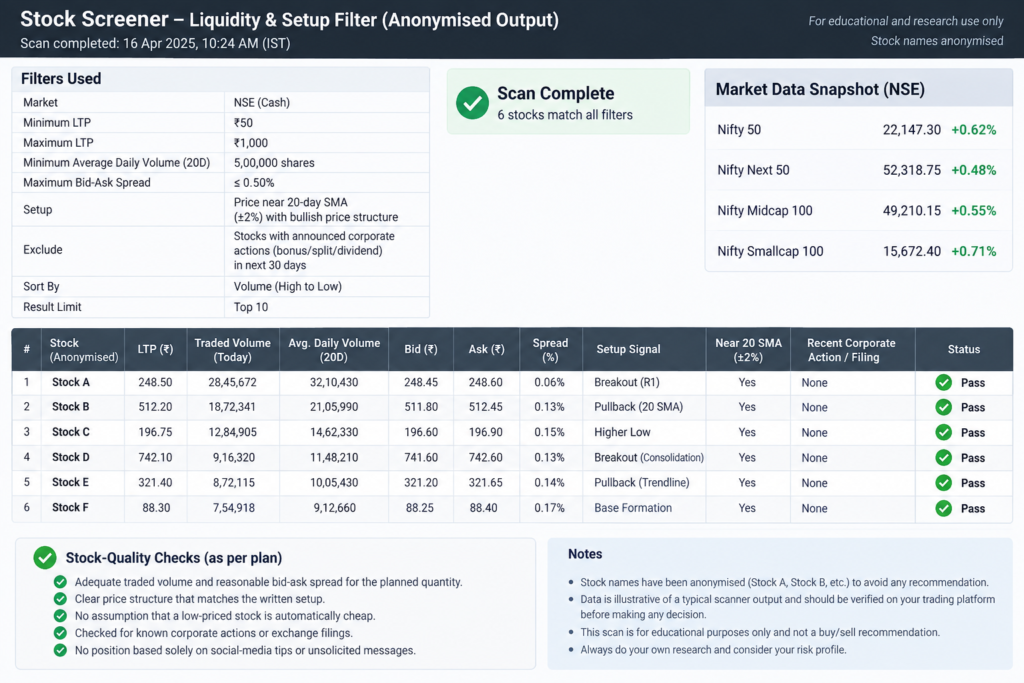
A stock should be checked for liquidity, spread, price behaviour, relevant disclosures and compatibility with the chosen setup. A chart pattern is not sufficient when orders may be difficult to execute near the expected price. Beginners should reject trades in which liquidity, event risk or the setup itself cannot be evaluated reliably.
Stock-quality checks
- Adequate traded volume and a reasonable bid-ask spread for the planned quantity.
- A clear price structure that matches the written setup.
- No unexplained assumption that a low-priced stock is automatically cheap.
- Known corporate actions or exchange filings that may affect the trade plan.
- No position based solely on social-media tips or unsolicited messages.
SEBI advises investors to deal with registered intermediaries, verify documents and avoid acting on unsolicited messages or promises of assured returns. Review the official investor guidance linked in the Sources section before publication.
4. Entry: What Exact Event Triggers the Trade?
A valid entry is an exact, observable price or condition that activates a previously defined setup. “The stock looks strong” is not an entry rule. The trader should know the trigger, order type, maximum acceptable price and no-chase condition before submitting the order.
- Write the trigger price or objective condition.
- Define whether confirmation is required at the close or during the session.
- Select the order type deliberately and understand its execution risk.
- Set a maximum acceptable entry price.
- Cancel the idea if the trigger occurs outside the permitted time or price range.
If price moves beyond the maximum acceptable entry, do not enlarge the stop or increase quantity to keep the original profit target attractive. Recalculate the trade or let it go.
NSE describes order conditions and the pre-open session on its official pages. An order instruction does not guarantee execution at a preferred price, particularly when liquidity or volatility changes.
5. Stop: Where Is the Trade Idea Invalidated?
A stop-loss should represent the price or condition at which the original trade thesis is no longer valid. It should be defined before position size is calculated. A random rupee amount or a stop moved farther away after entry can break the risk plan. Stop orders may also experience slippage and cannot guarantee the exact exit price.
- Place the invalidation level using the logic of the setup.
- Check that the level is not chosen only to permit a larger quantity.
- Account for gaps, spread and possible slippage.
- Define what happens if the order is not executed near the intended stop.
- Do not widen the stop merely to avoid recording a loss.
6. Size: How Many Shares Fit the Risk Limit?
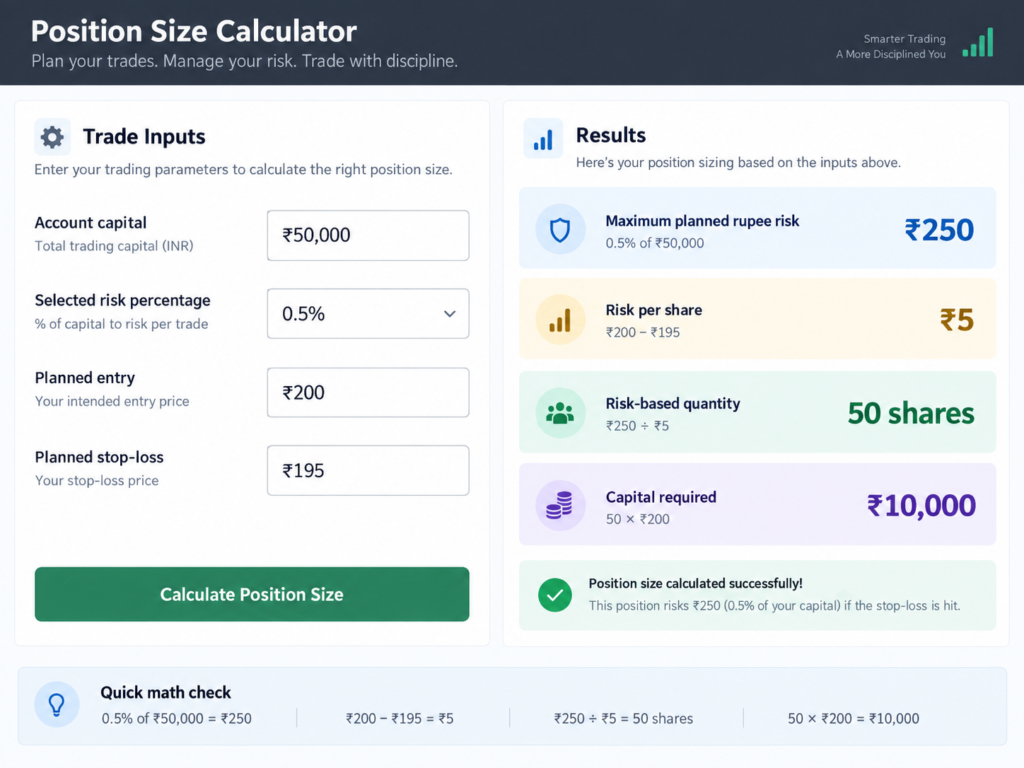
Position size should be calculated from account capital, the chosen risk percentage and the distance between entry and stop. The final quantity must also fit available capital, liquidity and applicable broker or exchange requirements. A risk-per-trade percentage is a personal risk-policy input, not a guaranteed safe level.
Worked Example: ₹50,000 Trading Account
The following is an illustrative example, not a stock recommendation or a claim that 0.5% risk is suitable for every person.
| Input | Illustrative value |
|---|---|
| Account capital | ₹50,000 |
| Selected risk percentage | 0.5% |
| Maximum planned rupee risk | ₹250 |
| Planned entry | ₹200 |
| Planned stop-loss | ₹195 |
| Risk per share | ₹5 |
| Risk-based quantity | 50 shares |
| Capital required | ₹10,000 |
If the planned target is ₹210, the gross planned reward is ₹10 per share and the gross reward-to-risk relationship is 2:1 before brokerage, statutory charges, spread, taxes and slippage.
A stop-loss limits planned risk, not guaranteed realised loss. A gap or poor liquidity can produce a worse exit. Brokerage, statutory charges, spread and slippage also reduce the net outcome.
Capital-Limited Quantity Versus Risk-Limited Quantity
The permitted position size is the lower of the risk-based quantity and the quantity affordable with allocated capital. A calculation that allows 50 shares by risk is still invalid if available capital, liquidity or applicable trading requirements support fewer shares.
When Should a Beginner Reject the Trade?
A beginner should reject a trade when the entry trigger or invalidation is unclear, the quantity cannot be calculated, liquidity is inadequate, the maximum entry has already been exceeded, or the idea depends on a tip or guaranteed-return claim. “No trade” is a valid checklist outcome.
- The setup cannot be described in one clear sentence.
- Market or sector conditions fall outside the written rules.
- The stock has inadequate liquidity or an unusually wide spread.
- The entry has moved beyond the maximum acceptable price.
- There is no logical invalidation level.
- The calculated loss exceeds the selected risk limit.
- The required capital or quantity is unsuitable.
- The trade depends on urgency, a tip or promised returns.
- A major uncertainty exists and the strategy has no rule for it.
Common Pre-Trade Checklist Mistakes
Completing the checklist after entry
The checklist becomes an explanation rather than a decision control.
Treating every item as a checkbox
A checked box is meaningless unless the supporting observation is recorded.
Using market direction as a prediction
Market context can support or weaken a setup; it cannot guarantee the stock outcome.
Choosing quantity before the stop
Quantity cannot be risk-based until the entry-to-stop distance is known.
Moving the stop to fit quantity
This changes the invalidation logic and planned loss.
Ignoring costs and slippage
The realised outcome may be worse than the planned gross result.
Chasing a missed entry
A wider stop or poorer price changes the original trade.
Making exceptions for tips
Urgency and social proof do not replace research.
Printable Pre-Trade Checklist
- ☐ MARKET — Relevant index and market condition recorded.
- ☐ MARKET — Scheduled event and gap/volatility risk considered.
- ☐ SECTOR — Sector or peer-group context recorded.
- ☐ STOCK — Liquidity, spread and setup compatibility checked.
- ☐ STOCK — Relevant disclosure/event risk checked.
- ☐ ENTRY — Exact trigger and order method written.
- ☐ ENTRY — Maximum acceptable price and no-chase rule written.
- ☐ STOP — Logical invalidation level written.
- ☐ STOP — Gap/slippage limitation acknowledged.
- ☐ SIZE — Rupee risk and risk per share calculated.
- ☐ SIZE — Final quantity fits risk, capital and liquidity.
- ☐ DECISION — Pass, Caution or Reject recorded with reason.
Methodology and Limitations
This framework is an original educational decision structure built around six linked questions: Market, Sector, Stock, Entry, Stop and Size. The numerical example is hypothetical. It uses a ₹50,000 account, an illustrative 0.5% risk input, a ₹200 entry and ₹195 stop. It is not a real trade, backtest or recommendation.
- The checklist cannot predict price direction or remove market risk.
- Risk tolerance and financial circumstances differ by person.
- A stop order may fill away from the intended price.
- Liquidity and costs can change between planning and execution.
- A valid process can still produce a losing trade.
- The framework must be tested against a clearly defined strategy and genuine journal records.
Key Takeaways
- Use the order Market → Sector → Stock → Entry → Stop → Size.
- Entry, stop and quantity must be defined before placing the order.
- Use Pass / Caution / Reject and record the reason.
- Calculate position size from rupee risk and risk per share.
- Use the lower of risk-limited and capital-limited quantity.
- Reject unclear, illiquid or chased trades.
- A checklist improves consistency; it does not guarantee a profit.
Sources and Further Reading
- Securities and Exchange Board of India (SEBI) — Do’s and Don’ts while dealing in the securities market. Accessed and reviewed 23 August 2026.
https://investor.sebi.gov.in/securities-dos_and_donts.html - Securities and Exchange Board of India (SEBI) — Financial Education Booklet. Accessed and reviewed 23 August 2026.
https://investor.sebi.gov.in/pdf/downloadable-documents/Financial%20Education%20Booklet%20-%20English.pdf - National Stock Exchange of India (NSE) — Trading system: order conditions. Accessed and reviewed 23 August 2026.
https://www.nseindia.com/static/products-services/emerge-sme-trading-system - National Stock Exchange of India (NSE) — Pre-open market session. Accessed and reviewed 23 August 2026.
https://www.nseindia.com/static/products-services/equity-market-pre-open
Educational Disclaimer
This material is for educational purposes only and is not investment advice or a personalised trading recommendation. Securities-market investments are subject to market risks.
Conduct your own research and, where appropriate, consult a SEBI-registered professional before making a financial decision.