
Scalping attracts many traders because potential profits and losses can appear within minutes. However, the same speed can empty a trading account just as quickly. Have you ever exited early, then watched prices continue, or bought before an instant reversal? That happens to many beginners. The difference usually isn’t luck. It’s preparation, discipline, and a repeatable process.
Scalping is a short-term trading approach where you open and close multiple trades within minutes or even seconds to capture small price movements. Success depends on efficient execution, disciplined Risk Management, proper Entry and Exit rules, and steady decision-making rather than predicting every market move.
Scalping rewards preparation more than speed. Many beginners assume faster trading automatically delivers rapid gains. Long-term traders typically succeed by following defined Trading Rules, preserving capital, and choosing High Probability Trades over impulsive entries.
If you enjoy fast-paced markets and short holding periods, scalping can become a practical Trading Style. However, it also demands focus, patience, and consistency. A few good decisions repeated daily often matter more than one spectacular trade.
Whether you trade stocks, Futures and Options, Commodity Trading, or Crypto, the same principles apply. Your objective is to trade only opportunities that match your strategy. Focus only on setups that fully match your trading strategy.
Important: Scalping involves substantial risk, and losses can occur quickly. This content is intended solely for learning and does not provide financial or investment recommendations. Always evaluate your own financial situation before trading with real money.
Table of Contents
What Is Scalping?
Scalping involves taking advantage of brief price fluctuations within extremely short trading periods. Instead of holding positions for hours or days, you may stay in a trade for only a few seconds or several minutes.
Each trade targets a modest gain. Over time, several disciplined trades can produce meaningful results.
Unlike Positional Trading, scalping requires accurate execution, disciplined habits, and consistent decision-making. Every decision matters because small mistakes can quickly erase several winning trades.
Good scalpers rarely rely on luck. Instead, they build repeatable habits that improve Trading Consistency over time.
Why Scalping Appeals to Active Traders
Experienced traders enjoy scalping because it provides regular opportunities throughout the trading session.
You may prefer scalping if you:
- Enjoy making quick decisions.
- Like monitoring live charts.
- Can stay focused for extended periods.
- Choose to close all positions before the trading session ends.
- Rely on a consistent process instead of emotional reactions.
At the same time, scalping is not about constant action. Waiting patiently often becomes your biggest advantage. A single well-planned trade usually beats several rushed entries.
Also Read: Hedging
Scalping Works Best When Market Conditions Match
Not every trading session suits scalping. Before opening a position, study the overall market environment. Strong liquidity, healthy Volume, and reasonable price movement usually create better opportunities than quiet or unpredictable sessions.
Ask yourself:
- Is the market trending or ranging?
- Has volatility increased naturally?
- Are spreads still reasonable?
- Is important news approaching?
If the answers create uncertainty, waiting often becomes the smarter decision.
Many successful traders first study the broader market before searching for entries on lower charts. This simple habit helps you avoid trading against the dominant direction.
News Trading Guidelines
Before every session:
- Review the economic calendar.
- Avoid entering immediately before major announcements.
- Wait for volatility to settle after unexpected news.
- Reduce position size during unusually volatile sessions.
Multi-Timeframe Analysis
Experienced traders usually analyze multiple charts before making trading decisions. Start by checking a higher Timeframe to understand the overall trend. Then move to a lower chart to refine your entry.
For example:
- 15-minute chart shows a bullish trend.
- 5-minute chart confirms momentum.
- 1-minute chart provides the entry.
When several timeframes point in the same direction, trade quality often improves.
| Timeframe | Typical Holding Period |
|---|---|
| 1-Minute | Seconds to 2 minutes |
| 3-Minute | 2–5 minutes |
| 5-Minute | Several minutes |
| 15-Minute | Less aggressive scalping |
Also Read: ETFs
Scalping Strategy Starts With Simple Rules
Many beginners search for a secret indicator. Experienced traders usually simplify their process instead.
A practical scalping routine may include:
- Identify the main trend.
- Mark important support and resistance.
- Wait for a clear Breakout or Pullback.
- Look for Confluence from price action.
- Confirm momentum with Volume.
- Calculate your risk before entering.
- Execute without hesitation.
- Exit according to your plan.
Simple routines are easier to repeat consistently.
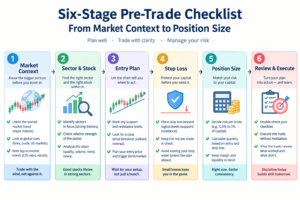
Pre-Trade Checklist
Before entering any trade, confirm:
If one important item is missing, waiting may be the better decision.
Trading Decision Flow
Trend
↓
Volume
↓
Liquidity
↓
Entry Signal
↓
Stop-loss Planned
↓
Risk Acceptable
↓
Enter Trade
Before placing any order, quickly walk through this sequence. When any key condition is missing, skip the setup and wait patiently.
Price Action Matters More Than Indicator Overload
Indicators can support your analysis, but they should never replace reading price itself.
Professional traders combine Price Action Trading with Candlestick Trading to improve timing. Patterns such as a Double Bottom, Double Top, or a strong rejection candle often provide useful confirmation near key levels.
Some advanced traders also study Smart Money Concept, Order Block Trading, Liquidity Concept, and Fibonacci Retracement. These tools work best when they support the overall market structure instead of creating unnecessary complexity.
Remember, adding more indicators does not automatically improve results. Simple market analysis often produces wiser trading decisions.
Also Read: Bear Market
Essential Tools for Scalping
Fast trading requires dependable tools.
Before your session begins, confirm that you have:
- A reliable internet connection.
- A responsive trading platform such as TradingView.
- Real-time market data.
- Quick order execution.
- Reliable computer or laptop.
- A prepared Trading Account Setup.
Even the best strategy can struggle if technology slows your execution.
Frequent trading can increase brokerage fees and other transaction costs, so include them when evaluating your overall performance.
Trading Setup Checklist
Choose Liquid Markets
Liquidity plays a major role in successful scalping. Markets with higher liquidity generally provide tighter spreads and smoother execution.
Popular choices include:
- Sensex and Nifty
- Bank Nifty
- MCX Gold
- Crude
- Natural Gas
- Major forex pairs
- Highly traded stocks
- Liquid index Options
Thin liquidity often causes greater slippage and reduces execution efficiency. Even a profitable setup can become less attractive if the bid-ask spread is unusually wide.
Liquidity Checklist
Before trading, verify:
Best Time to Scalp
Not every hour offers the same opportunities. Scalping usually performs better during active market sessions because liquidity and volume increase naturally.
Examples include:
| Market | Best Trading Hours |
|---|---|
| Stocks | First 60–90 minutes after market open |
| Forex | London–New York session overlap |
| MCX Commodities | Active global commodity sessions |
| Crypto | High-volume periods with strong momentum |
Avoid trading during lunch-hour slowdowns because lower volume often reduces quality opportunities.
Pre-Market Routine
Before the market opens:
- Review today’s news.
- Check the economic calendar.
- Mark key support and resistance.
- Identify the higher-timeframe trend.
- Prepare your watchlist.
- Decide your maximum daily risk.
- Test your internet and trading platform.
Five minutes of preparation often saves hours of emotional trading.
Also Read: Commodity Trading
Scalping Isn't About Trading More
One of the biggest misconceptions is that successful scalpers trade constantly. The opposite is often true. Experienced traders skip many setups because they know poor entries damage long-term performance. They focus on quality rather than quantity and protect every trade with sound Risk Management. Learning when not to trade is just as valuable as finding the right opportunity.
Also Read: Sector Rotation
Scalping Strategies That Work in Real Markets
Knowing what scalping is matters. Knowing when not to scalp matters even more.
Many beginners take every small price move as a trading signal. That habit often leads to poor entries and unnecessary losses. Instead, focus on situations where your strategy has a clear advantage.
Trade Only High-Probability Setups
Not every chart deserves your attention. A quality setup usually combines several supporting factors instead of relying on one signal.
Look for confirmation such as:
- A clear Price Action Trading structure
- A fresh Breakout from an important level
- Strong Volume supporting the move
- A respected Trendline
- A nearby Order Block Trading zone
- Confluence between multiple technical signals
- A clear market structure with Higher Highs and Higher Lows (or Lower Highs and Lower Lows)
The more quality factors align, the stronger your confidence should become.
However, avoid adding too many indicators. Clean charts often produce better decisions than crowded ones.
Choose the Right Timeframe for Scalping
Your timeframe directly affects trade quality. Most scalpers watch a higher chart first and then move lower for entries.
You can follow this simple process:
| Higher Timeframe | Entry Timeframe |
|---|---|
| 15-Minute | 1-Minute |
| 30-Minute | 3-Minute |
| 1-Hour | 5-Minute |
This habit helps you trade with the larger market direction instead of fighting it.
Never Underestimate the Importance of Liquidity
Scalping depends on quick execution. Poor liquidity creates wider spreads and unexpected slippage. Those small costs may seem harmless, yet they quickly reduce overall profits.
Highly liquid markets usually provide:
- Faster order execution
- Smaller spreads
- Lower slippage
- Better Entry and Exit opportunities
Many professional scalpers prefer major index futures, actively traded stocks, liquid forex pairs, or high-volume Commodity Trading instruments for this reason.
Also Read: Colour Trading
Scalping Risk Management Comes Before Profit
Many new traders focus on earnings. Successful traders prioritize capital protection above everything else. Without proper Risk Management, even an excellent strategy eventually struggles.
Keep Every Loss Small
Position Size = Maximum Account Risk ÷ Stop-Loss Distance
Example:
₹1,000 ÷ ₹20 = 50 shares
Here, ₹20 represents the planned stop-loss per share.
The stop-loss distance should be based on your trading setup, not on the amount you are willing to lose.
Scalping produces many trades. That makes position sizing extremely important.
A practical rule looks like this:
- Limit exposure by risking only a small portion on every trade.
- Never increase size after several wins.
- Never double exposure after losses.
Protecting your account keeps you in the game long enough to improve.
Set a Daily Loss Limit
Many professional scalpers stop trading after reaching their daily loss limit. Doing so helps prevent emotional decisions and protects trading capital during difficult sessions.
Many experienced traders also define a weekly loss limit. If that limit is reached, they step away, review their Trading Journal, and avoid forcing new trades until the following week.
Some traders also stop after reaching their planned daily profit target. Doing so helps protect gains and reduces the temptation to overtrade.
Respect Your Stop-Loss Every Time
Your stop-loss protects your trading idea. Moving it because you feel uncomfortable usually turns a small loss into a much larger one. Place your stop where your setup no longer makes sense. Then allow the trade enough room to work naturally.
Look for a Healthy Risk-to-Reward Ratio
Small profits do not mean poor planning. Every trade should still offer reasonable potential compared with the amount you risk.
Ask yourself:
- Does the potential reward justify the risk?
- Is the next resistance too close?
- Am I forcing this trade?
Sometimes skipping an average opportunity protects you from unnecessary losses. Many scalpers look for setups with Risk-to-Reward Ratios between 1:1 and 1:2, depending on their strategy and historical win rate.
Also Read: Market Capitalization
Scalping Psychology Often Determines Your Results
Active traders know their strategy. Far fewer control their emotions. Your mindset often decides whether you follow your Trading Rules when money is involved.
Progress by Experience Level
| Beginner | Intermediate | Advanced |
|---|---|---|
| One setup | Two setups | Personalized strategies |
| Small risk | Moderate risk | Strategy-based risk |
| Paper Trading | Live practice | Continuous optimization |
Avoid Common Scalping Mistakes
Fast markets encourage emotional decisions.
Watch for habits like:
- Chasing candles
- Entering late from fear of missing out
- Ignoring your stop-loss
- Increasing size after winning trades
- Revenge Trading
- Holding winners too long because of greed
- Overtrading after boredom
One emotional decision can erase several disciplined trades.
Build Trading Consistency Instead of Excitement
Many beginners chase action. Successful traders repeat good habits. Update your Trading Journal once each session ends.
Write down:
- Why you entered
- Why you exited
- What worked well
- What needs improvement
- Your mindset before entry and after closing the trade
Over time, your journal becomes one of your best teachers. It helps strengthen Trading Consistency while reducing repeated Trading Mistakes.
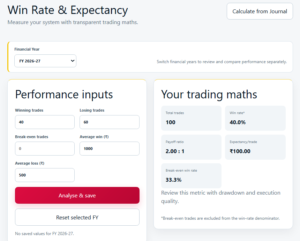
Track Your Trading Performance
Review these numbers every month:
| Metric | Why It Matters |
|---|---|
| Win Rate | Measures trading consistency |
| Average Reward | Reflects overall trade quality |
| Profit Factor | Compares total profits with total losses |
| Maximum Drawdown | Indicates the largest decline in account value |
End-of-Day Routine
After each session:
- Save screenshots.
- Review every trade.
- Record mistakes.
- Update your Trading Journal.
- Plan improvements for tomorrow.
Also Read: NiftyBees
Scalping Tips for Beginners
Learning scalping becomes easier when you simplify the process.
Start with these habits:
- Practice through Paper Trading first.
- Trade one setup until you master it.
- Follow one Trading Style consistently.
- Focus on liquid markets.
- Use reliable charting software like TradingView.
- Learn basic Candlestick Trading before adding indicators.
- Review every session honestly.
Progress comes from repetition, not constant strategy changes.
What Makes a Successful Scalper?
A successful scalping approach combines fast execution, strong Risk Management, strict discipline, and high-quality trade selection. Instead of predicting every market move, successful scalpers wait for high-probability setups, control losses, and follow the same process repeatedly.
Also Read: Pledge
Scalping vs Other Trading Styles
Choosing the right approach matters as much as learning the strategy itself. Traders who prefer fast decision-making often choose scalping. However, longer-term methods may suit you better if you prefer fewer trades and more patience.
| Trading Style | Holding Period | Trade Frequency | Best For |
|---|---|---|---|
| Scalping | Seconds to minutes | High | Fast decision-makers |
| Intraday | Minutes to hours | Medium | Active traders |
| Positional | Days to weeks | Low | Patient traders |
Pick the style that matches your personality rather than copying someone else’s success.
Also Read: Market Gap
Build the Right Scalping Setup
Reliable tools are essential for every successful strategy. Your trading setup should help you execute quickly and manage risk with confidence.
Example:
Use a Fast and Stable Platform
Slow execution can turn a winning setup into a losing trade.
Choose a platform that provides:
- Fast order execution
- Stable internet connectivity
- Reliable price feeds
- Quick Market and Limit Order placement
- Custom watchlists
- Real-time alerts
Many traders also use TradingView to analyze charts before placing orders.
Backtest Before You Trade Live
Validate your strategy before risking actual money. Start with Backtesting to see how your rules performed on historical charts. Next, move to Forward Testing or Paper Trading. This phase helps evaluate your strategy during actual market activity.
Practice first develops confidence and encourages calmer decision-making. Historical performance does not guarantee future results, so continue reviewing and adapting your strategy as market conditions change.
Also Read: Market Depth
Common Mistakes to Avoid
Most trading losses come from repeated habits rather than bad luck.
Watch for these common mistakes:
- Trading without a written plan
- Ignoring Risk Management
- Chasing late Breakout moves
- Trading during major news without preparation
- Using excessive leverage
- Entering low-liquidity markets
- Skipping your Trading Journal
- Ignoring Trading Psychology
Removing just one recurring mistake can noticeably improve your long-term performance.
Also Read: Circuit Limit
A Simple Real-World Example
In this example, the higher timeframe confirms the trend, the pullback offers the entry, volume supports the move, and the planned stop-loss keeps risk under control. Because every condition matches the trading plan, the trade is executed confidently instead of emotionally.
Even if the trade had resulted in a small loss, following the plan would still make it a good trade because disciplined execution matters more than the outcome of any single position.
Also Read: How to Use Stock Heatmaps
What Is the Best Way to Start Scalping?
The best way to start scalping is to learn one strategy, practice through Paper Trading, validate it with Backtesting and Forward Testing, follow strict Risk Management, and record every trade in a Trading Journal before increasing position size.
Also Read: Trading Failure
When Not to Scalp
Also Read: Market Cycle
Myths vs Facts
| Myth | Fact |
|---|---|
| Scalping guarantees quick money. | Consistency matters more than speed. |
| More trades always increase profits. | Better setups usually outperform frequent trading. |
| Indicators alone create winning trades. | Discipline and Risk Management have a greater impact on long-term success. |
Also Read: Muhurat Trading
Frequently Asked Questions
Is Scalping Suitable for Beginners?
Yes, but beginners should start with small position sizes and practice through Paper Trading before risking real money.
Which Markets Work Best for Scalping?
Highly liquid markets usually work best, including stocks, forex, index futures, MCX commodities, and selected Options contracts.
Which Indicators are Commonly Used for Scalping?
Disciplined traders combine RSI, Bollinger Band, moving averages, volume, and pure Price Action Trading instead of relying on many indicators together.
Can Scalping Become Profitable?
Yes. Profitability depends on discipline, execution speed, consistent Risk Management, and following proven Trading Rules.
How Much Time Should You Practice Before Trading Live?
There is no fixed timeline. Keep practicing through Backtesting and Forward Testing until your execution remains disciplined.
How Many Trades Should a Beginner Take Each Day?
Quality matters more than quantity. New traders often progress faster with a few quality trades rather than frequent entries.
Also Read: EGR
Final Thoughts
Scalping rewards preparation more than prediction. Quick trades alone do not create lasting success. Consistent execution, disciplined Trading Psychology, and sensible Risk Management make the real difference.
Focus on one setup before exploring several strategies. Build confidence through Backtesting, strengthen your skills with Paper Trading, and review every session in your Trading Journal. Master the process, and better results often follow naturally.
Every professional trader was once a beginner. Keep learning, manage risk wisely, and improve one trading session at a time.
Also Read: Trading Taxes