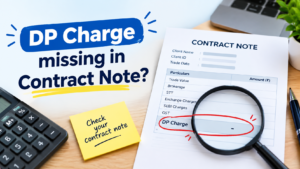
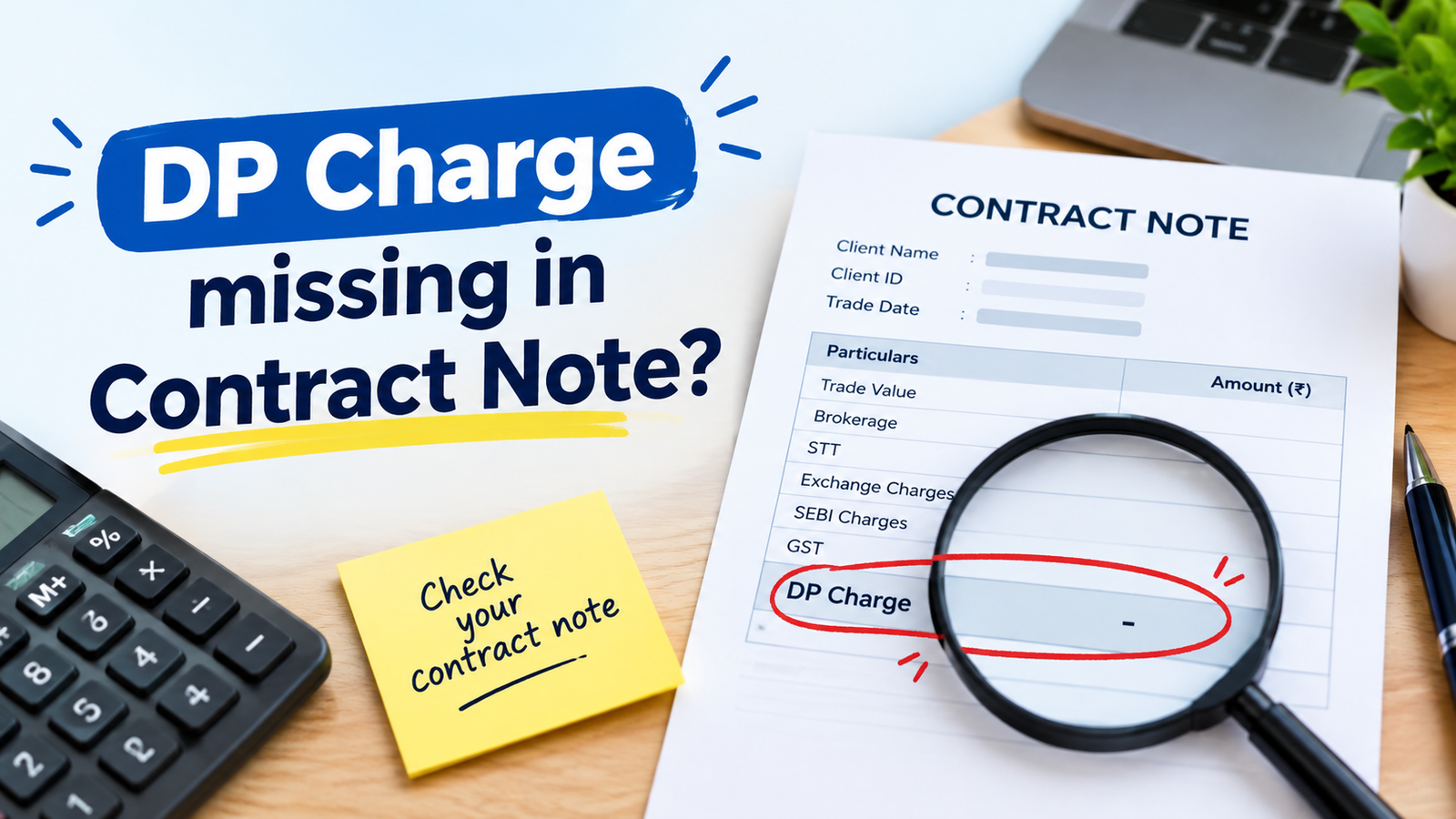
You sell shares, open the contract note, and check every line: brokerage, STT, exchange charges, GST and stamp duty. The sale went through. The charges are there. Yet the DP charge you expected is nowhere on the document. That does not automatically mean the broker missed it.
In most cases, the answer is simpler: a contract note records the trade at the exchange, while a DP charge arises when securities are debited from the demat account. These are connected events, but they are not recorded in the same place. That is why the contract note and the funds ledger need to be checked together.
Direct answer: charges are usually absent from a contract note because they relate to a demat debit, not to the exchange trade itself. Look for the debit in your broker’s funds statement or ledger instead.
Table of Contents
Think of It as Two Different Records
The easiest way to understand this is to stop treating the contract note as a complete account statement. It is not meant to show every charge that can ever hit your trading account.
Record One: The Contract Note
The contract note is the document for the trade you placed on the exchange. It normally tells you what was bought or sold, the quantity, price, brokerage and trading-related statutory or regulatory charges.
In other words, it answers this question: “What happened when my order was executed?”
Record Two: The Funds Ledger
The funds ledger is broader. It captures money moving into or out of your trading account. A depository-related charge can show up there even when it does not appear in the trade document.
It answers a different question: “What debits and credits have been posted to my account?”
Once you separate these two records in your mind, the missing DP charge stops looking mysterious.
Also Read: Nifty Expiry
What Does “DP Charge” Actually Relate To?
DP stands for Depository Participant. When you sell delivery shares held in your demat account, the shares have to move out of that account for settlement. That debit is the event linked to a DP charge.
The broker may also be a DP, or may work through one. The final amount charged to an investor can depend on the broker or DP’s own published tariff, so do not copy a rupee amount from another broker’s article and assume it applies to your account.
What matters for this article is the location of the entry: the charge is generally posted to the ledger rather than being listed in the contract note’s trade-charge section.
Also Read: What is EGR
A Simple Example: One Sale, Two Documents
Imagine that Riya sells 12 delivery shares of a company from her demat holdings. On the trade day, she receives a contract note. It shows the sale details and the costs tied to the trade, such as brokerage and applicable levies. Later, she looks at her funds statement and sees another debit labelled DP charge, depository charge, or a similar description.
Nothing has been charged twice merely because two documents exist.
| Where Riya Looks | What She Sees | Why It Appears There |
|---|---|---|
| Contract note | Sale quantity, sale value, brokerage, and trade-related levies | These belong to the exchange transaction |
| Funds ledger | A separate DP/depository debit | This relates to securities leaving the demat account |
The two entries describe different parts of the same overall sale process.
Also Read: Scalping
Where to Look for the DP Charge
Open your broker’s Funds Statement, Ledger, or Transaction Ledger. The exact menu name differs by broker.
When reviewing the ledger, use the trade date and the next few settlement-related entries as your reference point. Search for wording such as:
– DP charge
– Depository charge
– Demat debit charge
– CDSL or NSDL-related debit
Do not expect every broker to use the same label. The most reliable method is to compare the date, the amount and the sale that took place around it.
Also Read: Bullion
A Quick Reconciliation Method
Use this small checklist when a sale does not seem to add up:
- Find the delivery-sale entry in the contract note.
- Note the security, trade date and net settlement amount.
- Open the funds ledger for the same period.
- Look for a separate depository or DP debit.
- Compare it with your broker’s current DP tariff page.
This takes less time than trying to force every account debit into the contract note.
Also Read: Leverage
Why the Charge May Appear More Than Once
Seeing two DP debits does not always mean there is an error. The charging method depends on the broker’s tariff and how the depository debit is processed.
For example, charges can differ when you sell different securities, when settlements are treated separately, or when settled holdings and T1 holdings are involved around a settlement holiday. The exact treatment is broker-specific.
Before raising a complaint, check three things:
Were You Selling Different ISINs?
Two different stocks are two different securities. A tariff that applies per security can result in more than one DP-related entry.
Also Read: Candlestick Psychology
Was There More Than One Settlement Event?
The dates of the trade, settlement and demat debit may not always look identical in a ledger. Review the transaction descriptions instead of checking only the first sale date.
Did You Sell T1 and Settled Holdings Together?
Some brokers explain that separate settlement treatment can lead to two DP charges in this situation. Check your broker’s own tariff or support page before drawing a conclusion.
Also Read: Volume
Charges That Are Also Commonly Absent From a Contract Note
DP charges are not the only entries that can live outside the contract note. Depending on the broker, you may also see separate ledger postings for items such as:
– Annual maintenance charges
– Payment-gateway charges
– Call-and-trade charges
– Delayed-payment charges
That is why a full review of your account should include both the contract note and the funds ledger.
Also Read: Forex Trading
Contract Note vs Funds Ledger: Keep This Difference Handy
| If You Need to Verify… | Start With… |
|---|---|
| Price, quantity, and executed trade | Contract note |
| Brokerage, STT, exchange charges, and similar trade levies | Contract note |
| A DP or depository debit | Funds ledger |
| Account-level debits and credits | Funds ledger |
This table will not replace your broker’s documents, but it can save you from looking for the right number in the wrong place.
Also Read: Tax
When You Should Contact Your Broker
Contact support if the ledger shows a charge that you cannot connect to any sale, if the amount does not match the broker’s published tariff, or if the account was debited after an order that was cancelled or never executed.
When raising the ticket, include:
– The date of the ledger debit
– The charge description and amount
– The relevant contract-note number, if available
– The security and sale date you believe it relates to
A precise support request gets a more useful answer than “Why was I charged?”
Also Read: Gold Trading
Frequently Asked Questions
Are DP Charges Charged When I Buy Shares?
DP charges are associated with debit of securities from the demat account, which commonly occurs on a delivery sale. Check your broker’s tariff for the exact charge structure that applies to your account.
Do DP Charges Apply to Intraday Trades?
Why Does My Contract Note Show Many Charges but Not the DP Charge?
The contract note focuses on the exchange trade and its related levies. A DP charge is usually posted as a separate account debit in the funds ledger.
Can I Find DP Charges in a Contract Note PDF?
Usually, no. Start with the broker’s funds statement or ledger. If the entry is still unclear, compare it with the broker’s tariff and ask support for a transaction-level explanation.
Is a DP Charge the Same as Brokerage?
No. Brokerage is the broker’s charge for executing a trade. A DP charge is related to the demat-side debit of securities. They may both be connected to a sale, but they are different charges.
Also Read: Futures & Options
Final Takeaway
A contract note is not incomplete just because it does not show a DP charge. It is doing a different job from your funds ledger.
For every delivery sale, keep the contract note and ledger entry together. The first document explains the exchange transaction; the second helps you spot depository-related and account-level debits. Looking at both is the cleanest way to understand the real cost of a sale.
This article is educational and does not state the tariff of any individual broker. Charge descriptions and rates can change, so verify the current schedule published by your broker before relying on a specific amount.
Also Read: Price Action Trading