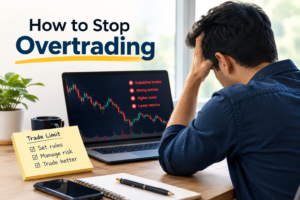
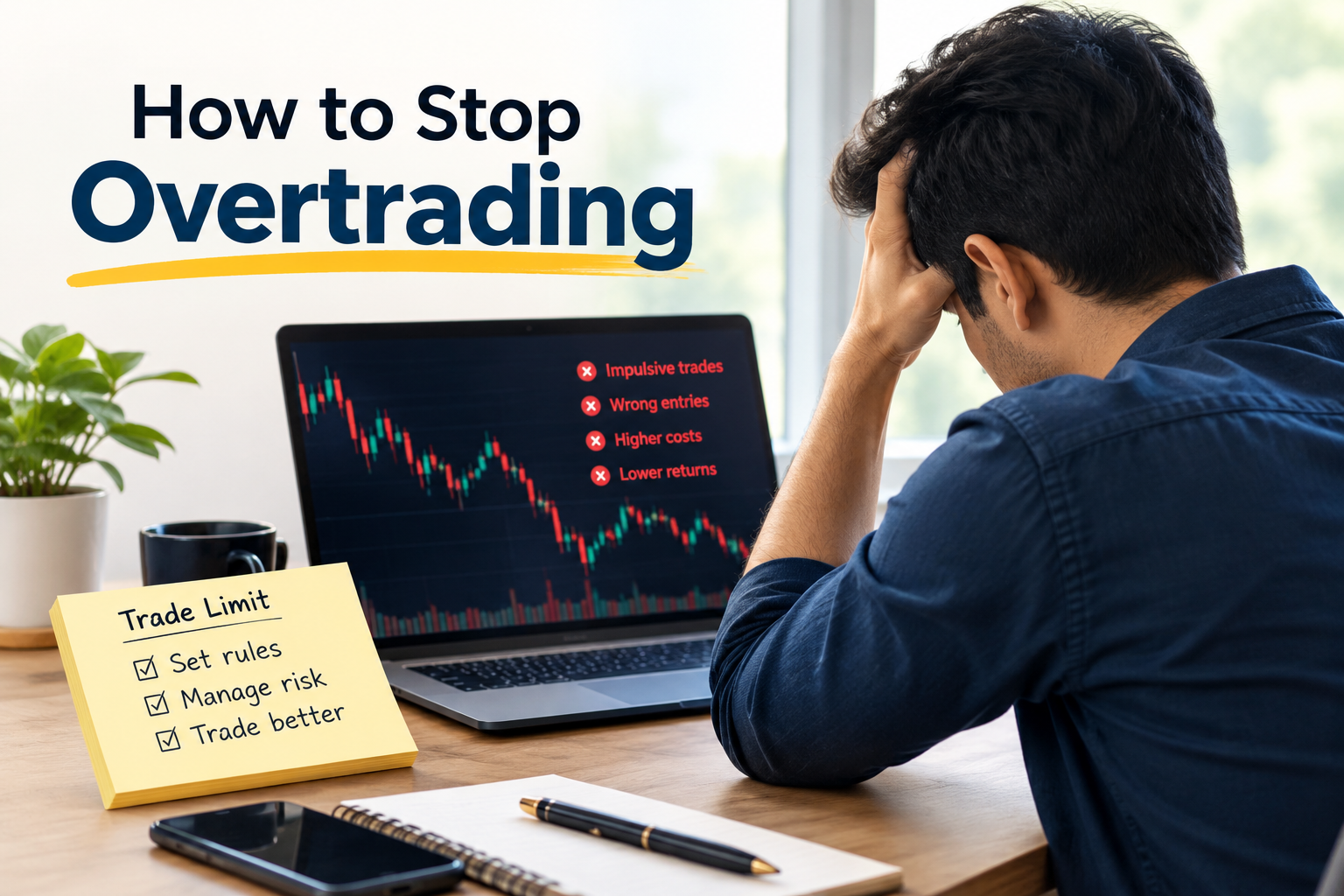
Overtrading is not defined by a universal number of trades. It occurs when trade frequency, position size or repeated entries exceed the rules and opportunities supported by your plan. To stop it, define valid setups, cap daily risk and trade count, use a post-loss cooldown, and review the cost of all rule-breaking trades separately from normal strategy losses.
A trader may take eight valid trades on an unusually active day and still follow the plan. Another trader may take only two trades and overtrade if the second entry has no setup, exceeds the risk limit or exists only to recover the first loss. The useful test is not “Did I trade a lot?” It is “Did each trade meet a rule that existed before the session?”
In my five years of market experience, I have found that overtrading often becomes visible only after the session. While the market is open, each extra entry can feel reasonable. A written limit and a journal make the change in behaviour easier to see before a small mistake becomes a sequence.
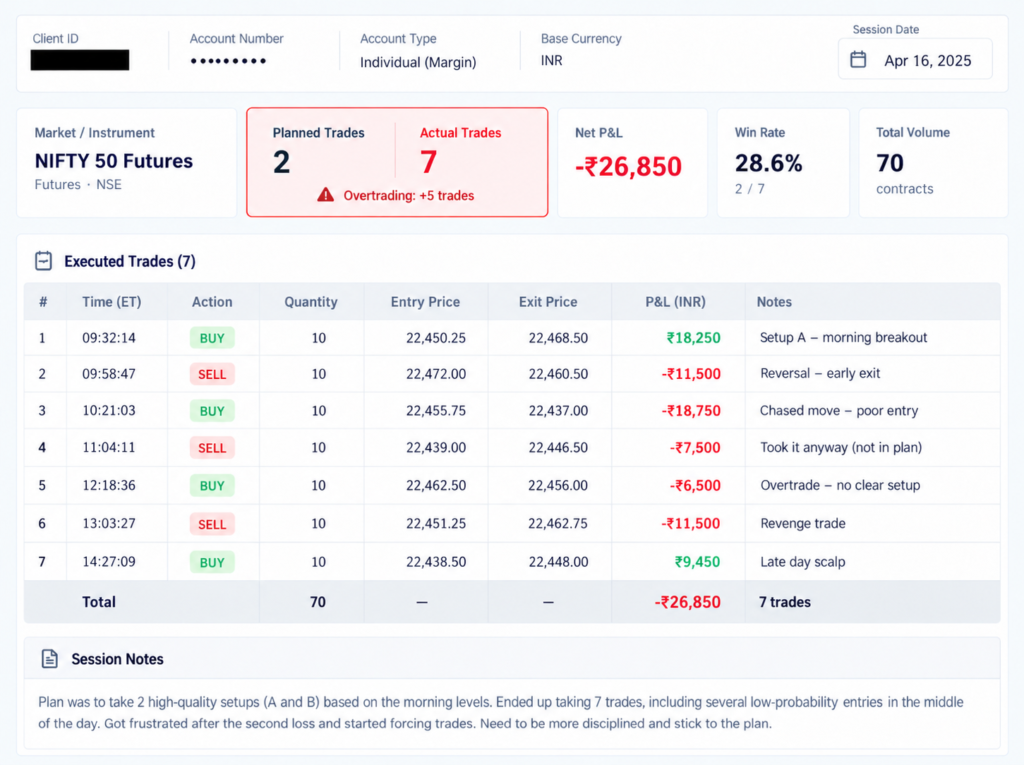
Table of Contents
What overtrading means
Overtrading means taking more trades, more exposure or more repeated entries than a defined strategy and risk plan justify. It can appear as high frequency, but frequency alone is not enough. A scalping method may generate many valid signals, while a swing strategy may generate only a few. The definition must be tied to the method being traded.
Overtrading is a measurable departure from a trader’s predefined process. It includes trades without a valid setup, entries beyond a trade-count limit, risk above the planned amount, repeated re-entry after a loss, or continued trading after a daily stop condition. A high trade count is evidence of overtrading only when it exceeds what the strategy and risk rules allow.
Academic evidence supports caution about excessive activity. Barber and Odean studied 66,465 brokerage households from 1991 to 1996. In that sample, the households that traded most earned lower net returns than the market. The study examined US stock investors from an earlier period, so its exact figures should not be copied as a forecast for Indian intraday or derivatives traders. Its relevant lesson is narrower: frequent activity must overcome its added costs before it improves net results.
SEBI reported that 93% of individual equity F&O traders incurred losses over FY22 to FY24. The finding does not prove that overtrading caused those losses. Leverage, strategy quality, transaction costs, market conditions and execution also matter. It does show why trading frequency should be measured instead of assumed to be harmless.
Also Read: How to Identify False Breakouts
How many trades per day are too many
There is no universal maximum number of trades per day. The appropriate limit depends on how often a tested setup appears, the instrument, timeframe, transaction costs, daily risk budget and the trader’s ability to execute consistently. Overtrading begins when a new position cannot be justified by the same setup and risk rules used for the first trade.
A fixed number can still be useful as a temporary safety limit, especially for a beginner who has identified a pattern of impulsive entries. However, the number should come from journal or backtest evidence rather than an online rule such as “never take more than two trades.”
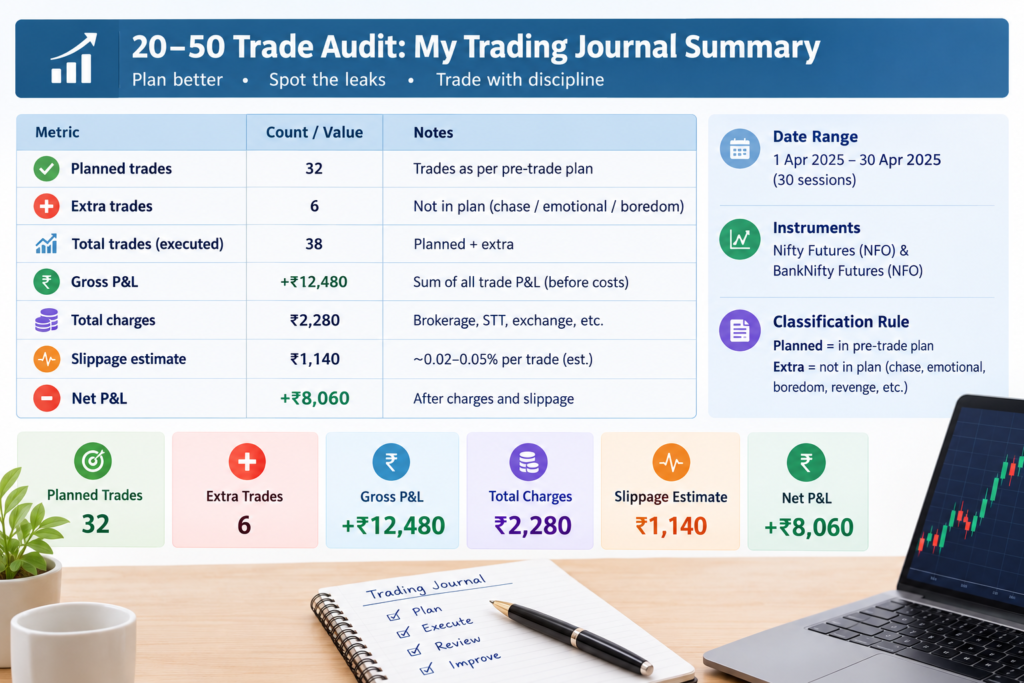
Review at least 20 to 50 comparable sessions and ask how many valid setups normally occurred, whether later trades had lower rule-adherence scores, and how costs changed as frequency increased. A limit should protect the process without blocking legitimate signals that the strategy was designed to take.
Also Read: Breakout
Seven signs of overtrading
| Sign | Observable behaviour |
|---|---|
| No named setup | You cannot describe the entry using the written rules. |
| Trade count creep | The session limit changes after it is reached. |
| Rapid re-entry | A new order follows a stop-out before an independent setup is checked. |
| Size escalation | Quantity increases to recover a loss or exploit a winning mood. |
| Lower standards | A marginal signal is accepted because no trade has appeared. |
| Ignored stop condition | Trading continues after the daily risk or loss limit is reached. |
| Hidden activity | Trades are omitted from the journal or described vaguely during review. |
Also Read: Short Selling Mistakes
Why traders overtrade
FOMO after a missed move
Revenge after a loss
Overconfidence after a win
A strong result can make normal limits feel unnecessarily restrictive. The trader may increase size or accept weaker setups because recent success is treated as evidence that judgement has improved.
Boredom and the need for action
Unclear strategy rules
Also Read: Trendlines
How extra trades affect costs and expectancy
Every additional trade must overcome brokerage, statutory charges, bid-ask spread, slippage and taxes that apply to the instrument and transaction. Current rates vary by broker and product, so verify them rather than copying a fixed cost from an example.
Assume a plan allowed three trades but nine were taken. The six extra trades had an illustrative combined round-trip friction of ₹100 each, including estimated charges and slippage.
| Calculation | Illustrative value |
|---|---|
| Extra trades | 9 − 3 = 6 |
| Estimated friction per extra trade | ₹100 |
| Added friction | 6 × ₹100 = ₹600 |
| Extra-trade gross P&L | −₹900 |
| Extra-trade estimated net effect | −₹1,500 |
This is a simplified illustration, not a claim about typical costs. The actual figure should be calculated from contract notes and execution data. Even profitable extra trades should be reviewed for rule adherence because a lucky outcome can reinforce a poor process.
Overtrading reduces net expectancy when the additional trades do not add enough gross edge to cover their losses, charges, spread and slippage. Measure the extra trades as a separate sample. If they perform worse than planned trades after costs, reducing them may improve results without changing the core strategy.
Also Read: 10 Trading Mistakes
A practical trade-limit system
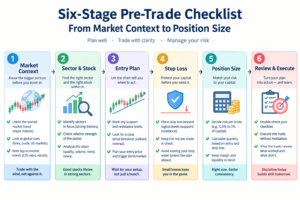
The purpose of a trade-limit system is to make the stopping decision before the session becomes emotional. Use limits that match your tested strategy and financial circumstances.
| Rule | Implementation |
|---|---|
| 1. Setup whitelist | List the exact setups allowed for the session. No named setup means no trade. |
| 2. Risk per trade | Define the intended rupee risk and calculate quantity from the stop distance. |
| 3. Daily risk ceiling | Set the maximum combined realised and open risk you are prepared to accept. |
| 4. Trade-count guardrail | Set a temporary maximum based on historical valid opportunities. |
| 5. Cooldown trigger | After a loss or rule violation, block new orders for a predefined period and rerun the checklist. |
| 6. Stop condition | End the session when the risk ceiling, violation limit or mental-readiness rule is reached. |
| 7. Review | Tag planned and extra trades separately and compare their net outcomes. |
The system does not guarantee profitability. It controls exposure to a known behavioral leak. A strategy with negative expectancy can still lose money even when every limit is followed.
If I reach my daily trade-count or risk limit, then I will close the order window and record the session. I will not increase the limit because a new trade looks attractive. Any exception must be defined before the session and supported by the strategy rules.
Also Read: Sector Rotation
A pre trade filter for an additional entry
- ☐ Can I name the setup without referring to the previous trade?
- ☐ Does the entry still satisfy the original market and stock conditions?
- ☐ Is the stop based on invalidation rather than the amount I want to risk?
- ☐ Does the position fit within the remaining daily risk budget?
- ☐ Am I increasing size because of a previous win or loss?
- ☐ Has the cooldown rule been completed?
- ☐ Would I take this trade if today’s P&L were hidden?
- ☐ Will I record this trade even if it loses?
Do not take the additional trade when its justification depends on recovering a loss, protecting a winning day or avoiding the discomfort of missing a move. Recheck it as a new decision with the same setup, risk and position-sizing rules applied to the first trade.
Also Read: Commodity Trading
A journal audit for overtrading
| Field | What to record |
|---|---|
| Sequence | Trade number and time |
| Classification | Planned, exception or rule-breaking |
| Trigger | Valid setup, FOMO, boredom, revenge or overconfidence |
| Risk | Planned and actual rupee risk |
| Timing | Minutes since the previous exit |
| Costs | Brokerage, statutory charges and estimated slippage |
| Result | Gross and net P&L, plus R multiple |
| Process score | Applicable rules followed divided by applicable rules |
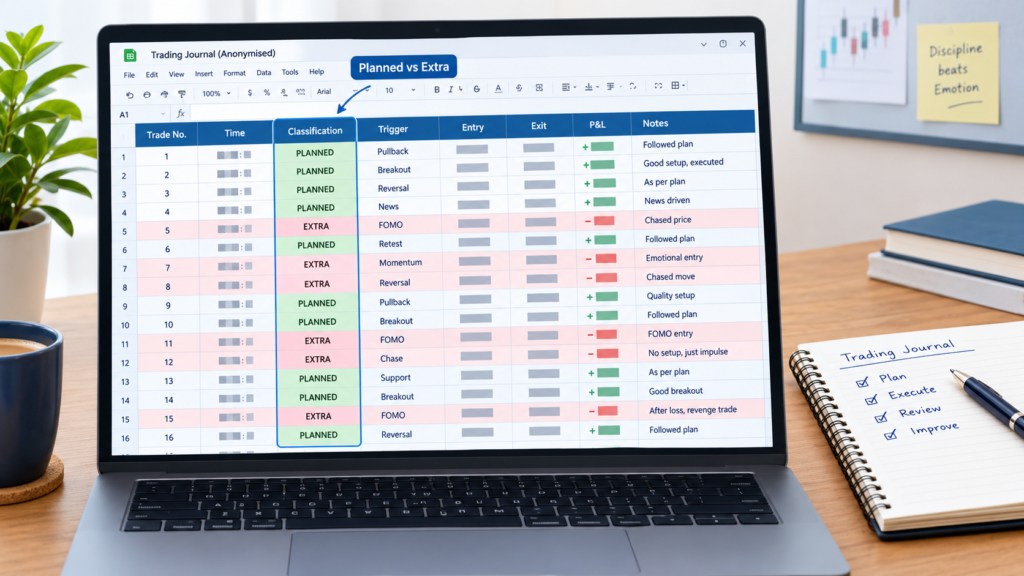
Metrics to calculate
- Extra-trade rate = Extra trades ÷ Total trades
- Post-loss re-entry rate = Re-entries within your chosen interval ÷ Losing trades
- Size-violation rate = Trades above planned risk ÷ Total trades
- Net cost of extra trades = Extra-trade gross P&L – charges – slippage
- Rule-adherence rate = Rules followed ÷ Applicable rules
These measures identify associations in your own records. They do not prove that an emotion caused a financial result. Use consistent definitions and a sufficiently broad sample before changing a strategy.
Also Read: Futures Trading
A 14 day overtrading reset plan
Days one to three establish the baseline
Record every trade, including cancelled orders and immediate re-entries. Do not rely on memory at the end of the week. Note the planned trade count and the actual count.
Days four to seven apply one guardrail
Days eight to eleven separate the samples
Days twelve to fourteen set the next review rule
Keep the guardrail if it reduces the targeted violation without blocking the strategy’s normal signals. Revise it if the definition is ambiguous. If loss-chasing or trading behavior feels difficult to control and is causing financial or emotional harm, stop trading and seek appropriate professional support.
Also Read: Morning Star & Evening Star
Frequently asked questions
What is overtrading in simple words?
Overtrading is taking more trades or more risk than your written strategy and risk plan justify. It is identified by rule violations, not by a universal daily number.
Is three trades a day overtrading?
Not necessarily. Three trades may be valid for one tested method and excessive for another. Review whether each trade met the same predefined setup and risk rules.
Can overtrading happen with only one trade?
Yes. A single position can represent overtrading when its size exceeds the plan or when it is taken without a valid setup. Overexposure matters as well as frequency.
How can I stop overtrading after a loss?
Does a daily loss limit guarantee safety?
Can a trading journal stop overtrading?
Also Read: Bollinger Band
Key takeaways
- There is no universal correct number of trades per day.
- Define overtrading as a departure from your own tested setup and risk rules.
- Measure planned and extra trades as separate samples after costs.
- Create trade-count, daily-risk, cooldown and stop rules before the session.
- Judge process quality independently from the result of one trade.
- Use original journal data to decide whether a guardrail is helping.
Also Read: Golden Crossover
Educational disclaimer
This article is for educational purposes only and is not investment advice, a research report, a recommendation or an invitation to trade any security or derivative. Trading and investing involve risk, including the possible loss of capital. Examples are simplified and do not account for every cost, tax, liquidity condition, gap or execution risk. Consider your financial circumstances and consult a SEBI-registered professional when appropriate.
Also Read: Nifty Reversal
Sources and further reading