Gold and silver have attracted traders for centuries. Even today, many traders watch them every day. Why? Because these metals move with global news, inflation fears, and market sentiment. Those movements create gold and silver trading opportunities for traders who understand the market structure.
You might see gold rise during uncertainty. Meanwhile, silver often moves faster because of industrial demand. So when you learn how these two metals behave, trading decisions become clearer.
In today’s markets, traders often analyze gold price charts, silver price trends, and global commodity signals before placing trades. Understanding these broader market movements helps traders identify better entry and exit points in gold and silver trading.
Let’s explore practical gold and silver trading strategies that can help you trade with more confidence.
Table of Contents
Why Gold and Silver Attract Traders
Gold and silver rank among the world’s most widely traded commodities. They offer liquidity, volatility, and global participation.
Several factors move these metals:
- Increasing expectations of inflation across the economy
- The US dollar’s strength or decline
- Changes in policy interest rates announced by central banks
- International tensions or geopolitical risks
- Industrial demand from manufacturing and technology sectors
Long-term market research suggests gold has averaged roughly 7–9% yearly returns over decades. Return estimates differ by timeframe and method, often using historical data from groups like the World Gold Council. Research from organizations such as the World Gold Council highlights gold’s role as a long-term store of value during periods of inflation and economic uncertainty. That’s why investors treat it as a hedge against inflation.
Gold prices also tend to move inversely with the US Dollar Index (DXY). When the dollar weakens, gold often strengthens because it becomes cheaper for global buyers. Silver shows higher volatility compared with gold, which is why short-term traders frequently monitor it for faster price movements.
However, silver behaves differently because it reacts both to economic growth and safe-haven demand. This dual role often causes silver prices to swing more sharply.
That volatility can create excellent trading setups.
Have you ever noticed how gold suddenly rises during economic uncertainty? Observing these patterns over time can help traders understand why precious metals behave differently from stocks or currencies.
Also Read: ChatGPT vs. Google in Trading
Getting Started with Gold and Silver Trading
Gold and silver trading refers to buying and selling these precious metals through financial instruments such as futures contracts, exchange-traded funds, or spot market trades. Traders aim to profit from price movements caused by economic events, currency fluctuations, and global market sentiment.
For many new investors, gold and silver markets are often the first step into commodity trading for beginners, because these metals are widely traded and easier to analyze compared with many other commodities.
Before placing a trade, you should understand the basic mechanics of commodity trading.
Most traders in India use the Multi Commodity Exchange (MCX).
Let’s quickly review a few essential basics:
Gold contract details (approximate):
- Standard lot size: 1 kg for Gold futures, although smaller contracts such as Gold Mini and Gold Guinea are also available
- Mini lot: 100 grams
- Trading hours: roughly 9 AM to 11:30 PM
- Margin requirement: varies with volatility
Silver contract details:
- Standard contract lot size: 30 kg
- Mini lot: 5 kg
Many beginners start gold and silver trading without understanding how the market structure works. Learning how to trade gold and silver step-by-step can reduce unnecessary risk. Traders in India often participate through MCX gold trading and MCX silver trading, which are part of the broader commodity futures trading India market. When traders understand contract specifications and price drivers, building a consistent gold and silver trading strategy becomes much easier.
Margin requirements often change as market volatility rises or falls. For example, trading a Gold Mini contract may require roughly ₹40,000–₹60,000 margin, though the exact amount depends on broker policies and market conditions. Understanding margin helps beginners avoid over-leveraging their accounts.
Also, many traders practice using paper trading before entering real trades.
Also Read: Morning Star & Evening Star
How Gold and Silver Trading Actually Works
Many beginners hear advice like “use technical analysis.” But that advice is vague. Instead, you need specific strategies.
Here are several popular strategies traders often use.
Also Read: NiftyBees
Moving Average Strategy
Moving averages help traders identify the market’s trend direction.
A typical trading setup often includes these indicators:
- Moving average calculated over the past 50 days
- Moving average based on the last 200 trading days
When the 50 MA moves above the 200 MA, traders call it a golden crossover. This pattern can indicate the beginning of a strong upward trend.
Example:
If gold nears ₹72,000 with a golden crossover, traders may consider buying. Traders also choose different timeframes depending on their trading style.
- Intraday traders often use 5-minute or 15-minute charts.
- Swing traders prefer 1-hour or 4-hour charts to identify stronger trends.
Many traders pair moving averages with volume indicators or Bollinger Bands. Volume helps confirm whether a breakout has strong market participation. When volume increases during a breakout, the probability of trend continuation usually improves.
Also Read: Pledge
RSI Momentum Strategy
Momentum indicators help identify overbought or oversold market conditions. One popular tool is the Relative Strength Index (RSI), which helps identify momentum shifts.
Typical signals traders watch for include:
- RSI under 30 often suggests the asset may be oversold
- RSI above 70 commonly signals overbought market conditions
Suppose silver drops quickly and RSI falls near 28. Some traders wait for a rebound before opening long trades. However, combining RSI with trendlines improves accuracy.
Another common scenario appears during support zones. When silver approaches ₹84,000 support and RSI drops under 30. If the price stabilizes and RSI begins moving upward, some traders interpret this as a potential bounce setup and enter a cautious long trade.
Also Read: Market Gap
Trading Breakouts
Breakouts often produce strong price moves.
- Mark the key support and resistance levels
- Wait for price to break the level
- Confirm with strong volume
Example:
Gold trades between ₹72,000 and ₹72,500.
If price breaks ₹72,500 with strong volume, traders may enter a long trade.
Traders may then look for a potential target near ₹73,200.
When studying breakout strategies, many traders analyze historical charts to identify similar setups. For better understanding, traders often review historical price charts that highlight support and resistance zones, breakout candles, and volume spikes. Studying these examples helps beginners visually recognize how breakout setups develop in real market conditions.
Also Read: How to Know the Best Strike Price in Options
Best Time to Trade Gold and Silver
Timing plays a big role in commodity trading.
Gold and silver become most active when global markets overlap.
Times when market volatility usually increases:
- 2 PM – 5 PM (Indian time)
- 6 PM – 11 PM when US markets open
These active periods often coincide with major global trading sessions in London and New York, two of the world’s largest financial centers. The London and New York trading sessions usually create the strongest price movements because institutional traders and global investors participate heavily during these hours. During these hours, liquidity increases and price movement becomes clearer.
However, beginners should avoid trading during periods of low liquidity. Sudden spikes may appear without strong signals.
Understanding the market cycle also helps traders choose better entry timing.
Market liquidity in precious metals is often highest during overlapping global trading sessions, particularly when major financial centers like London and New York City are active.
Also Read: Nifty Reversal
Risk Management in Precious Metals Trading
Even effective strategies struggle without proper risk control and disciplined trading.
Smart traders focus heavily on protection.
Professional traders and risk managers often combine position sizing, stop-loss placement, and portfolio diversification to reduce risk when trading commodities like gold and silver.
Here are simple rules:
- Risk only 1–2% of capital per trade
- A stop-loss helps limit losses during unexpected price moves
- Avoid over-leveraging
Many traders ignore risk control. Eventually, one bad trade wipes out their profits.
Following a risk management strategy in trading can prevent that problem.
Also remember the concept of Risk to Reward Ratio for Best Results.
Example:
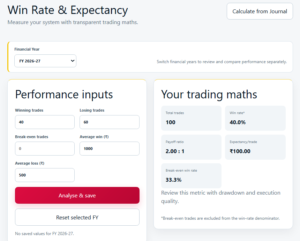
- Risk ₹500 per trade
- Target ₹1,500 profit
That creates a 1:3 reward-to-risk ratio.
Many professional traders emphasize strict risk management guidelines often taught in financial education programs and discussed by organizations such as the CFA Institute.
Also Read: 11 Crypto Insights
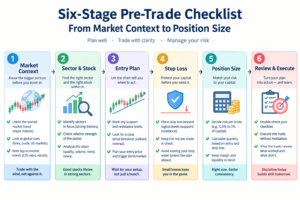
Quick Gold and Silver Trading Checklist
Before entering a trade, many disciplined traders review a quick checklist:
- Is the overall trend clear?
- Does the setup match your strategy rules?
- Is RSI or another indicator confirming the signal?
- Is the risk-to-reward ratio at least 1:2?
- Are there major news events approaching?
Using a checklist helps reduce emotional trading decisions.
Also Read: Fibonacci Retracement
Common Mistakes in Gold and Silver Trading
Even skilled traders sometimes make errors. However, beginners repeat a few errors frequently.
Common mistakes include:
- Using more leverage than the account can safely handle
- Trading during sudden news-driven price spikes
- Overlooking the overall market trend
You may also relate this to common trading mistakes that often destroy trading success.
Also Read: Circuit Limit
Gold vs Silver: Which One Should You Trade?
Both metals offer good opportunities. Yet their behavior differs.
Taking part in gold market trading
- Usually shows steadier price behavior
- High demand during market uncertainty
- Often experiences milder price fluctuations
Taking part in silver market trading
- Frequently shows stronger price fluctuations
- Industrial demand influence
- Can still produce noticeable short-term moves
Short-term traders often prefer silver because it moves faster.
Meanwhile, gold attracts traders who prefer smoother trends.
Understanding momentum trading techniques can help you adapt to both markets.
Also Read: How to Use Stockheatmaps
Using Futures for Gold and Silver Trading
Most traders access metals through futures contracts. Traders use these contracts to speculate on future prices.
For deeper understanding, many traders explore Futures Trading Success: 7 Genuine Ways to Profit Big.
Important futures concepts include:
- Contract expiry
- Capital needed as margin to start a trade
- Mark-to-market settlement
Because futures involve leverage, discipline becomes essential.
Also Read: 10 Proven Ways to be Patient in Trading
Building Confidence Through Testing
Before using real money, experienced traders test their strategies.
Two popular methods professional traders use include:
Backtesting analyzes historical charts. Meanwhile, forward testing checks strategies in real-time practice environments.
These steps help you avoid emotional decision-making.
Also Read: Trading Failure
Common Questions About Gold and Silver Trading
Is gold trading good for beginners?
Yes, gold trading can suit beginners because price trends are often clearer than many stocks. Still, beginners should start with small positions and practice risk management.
How much capital do you need to trade gold in India?
The amount depends on contract size and required margin. Mini contracts need less capital, making them popular with beginners.
Which indicator works best for gold trading?
Many traders combine moving averages, RSI, and support-resistance analysis. No indicator works perfectly alone, so combining tools improves reliability.
Why does silver move faster than gold?
Silver has both investment demand and strong industrial usage. Because of this dual role, its price tends to fluctuate more sharply.
Is gold or silver better for intraday trading?
Silver is often preferred for intraday trading because it shows higher volatility and faster price movements compared with gold.
Do global events affect gold and silver prices?
Yes. Events like inflation data, central bank announcements, and geopolitical tensions can significantly influence gold and silver prices.
Also Read: Market Order & Limit Order
Final Thoughts
Gold and silver trading becomes far easier once you understand how these markets behave. Instead of guessing, you start noticing patterns, trends, and timing signals.
The key is simple: start small, follow a clear strategy, and protect your capital. Over time, your confidence grows with experience.
Most successful traders didn’t begin with huge profits. They began with curiosity, discipline, and consistent learning.
If you keep studying the markets, testing strategies, and managing risk carefully, precious metals trading can become a powerful addition to your trading journey.
A practical next step is to practice these strategies using a demo account or paper trading platform. This allows you to test different gold and silver trading strategies in real market conditions without risking real money while building confidence and real trading experience.
Also Read: How to Open a Demat Account