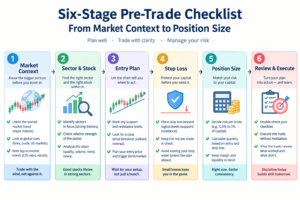

Trading consistency doesn’t come from one great trade.
It grows quietly, through repeated choices you make every day.
If your results feel random, you’re not broken. Most traders struggle here. One week feels confident. The next feels chaotic. That swing doesn’t mean you lack skill. It means your process hasn’t settled yet.
Think about learning to ride a bike. At first, balance feels impossible. Then one day, your body just knows. Trading works the same way. When actions repeat calmly, results begin to stabilize.
Let’s talk about how consistency actually forms — without pressure, hype, or shortcuts.
Table of Contents
What Trading Consistency Really Means
Consistency doesn’t mean winning every trade.
It means behaving the same way, no matter the outcome.
You follow your plan when trades win.
You follow it when trades lose.
That steady behavior is what separates progress from emotional guessing. When actions stay predictable, results slowly follow.
Also Read: ETFs
Also Read: Bull Market
Why Most Traders Struggle With Consistency
Also Read: Sector Rotation
Trading Consistency Starts With Simple Rules
Also Read: 10 Trading Mistakes
Focus on Process, Not Daily Results
Results fluctuate. Process compounds.
A single trade means little. A hundred similar trades reveal truth. When you judge yourself daily, emotions rise. When you judge weekly behavior, clarity improves.
Ask yourself:
- Did I follow my rules today?
- Did I respect my risk?
- Didn’t I stay impatient?
Consistency grows when process becomes the win.
Also Read: Double Top
How Trading Consistency Builds Emotional Stability
Also Read: Gift Nifty
Also Read: Trendlines
Risk Control Is the Backbone of Trading Consistency
Also Read: Colour Trading Mastery
Build a Routine That Supports Trading Consistency
Consistency grows outside the chart too.
Routine creates stability:
- Same trading hours
- Same preparation steps
- Again same review process
When your environment stays predictable, your behavior follows.
Also Read: ChatGpt Vs. Google in Trading
The Role of Patience in Consistent Trading
Also Read: What are Sensex and Nifty
Also Read: Commodity Trading
Trading Consistency Improves With Fewer Decisions
Decision fatigue ruins discipline.
Reduce choices:
Fewer decisions mean cleaner execution. Clean execution leads to consistency.
Also Read: How to Use TradingView
How Journaling Supports Long-Term Consistency
Also Read: Breakout Opportunities
Why Overtrading Breaks Consistency
More trades don’t mean more progress.
Consistency prefers fewer, intentional actions.
Also Read: Backtesting Mastery
Trading Consistency Grows Through Small Position Sizes
Big size magnifies fear.
Small size allows learning. It lets you focus on execution instead of money.
Confidence grows quietly when risk stays manageable.
Also Read: 12 IPO Strategies
Expect Slow Progress, Not Instant Control
Consistency isn’t dramatic.
Some days feel boring. Others feel repetitive. That’s normal. Stability often feels dull before it feels rewarding.
Slow progress lasts longer.
Also Read: Forward Testing
Common Habits That Destroy Consistency
Also Read: NiftyBees
Also Read: Pledge
How Breaks Improve Trading Consistency
Also Read: 11 Crypto Insights
Trading Consistency Comes From Self-Trust
Also Read: Morning Star and Evening Star
Measure Consistency the Right Way
Also Read: Bollinger Band
The Role of Environment in Trading Discipline
A cluttered screen, noisy room, or constant notifications quietly pull focus away from your plan.
Small environmental tweaks help:
When your space feels calm, your decisions follow.
Staying consistent feels simpler once distractions no longer challenge your trading rules.
This isn’t about perfection.
It’s about removing friction so discipline doesn’t feel exhausting.
Also Read: Golden Crossover
Also Read: How to Know The Best Strike Price in Options
Why Self-Awareness Matters More Than Willpower
Willpower fades. Awareness stays.
Many traders try to “force” discipline. That rarely works long term. Instead, noticing your patterns creates change naturally.
Pay attention to:
When you see patterns clearly, you stop fighting yourself.
You adjust systems instead of blaming emotions.
Consistency strengthens when awareness replaces self-criticism.
Also Read: Heikin Ashi Candle
How Long It Takes to Build Trading Consistency
Also Read: Nifty Reversal
When Trading Consistency Finally Clicks
One day, trades feel quieter.
You stop forcing moves. Losses feel manageable. Wins feel calm.
That’s consistency working in the background.
Also Read: Fibonacci Retracement
FAQs
Why does trading feel inconsistent even with a good strategy?
Can trading consistency exist without profits initially?
Yes. Consistent behavior often comes before consistent profits.
How does consistent risk improve results?
It keeps emotions stable and decisions clear.
Have you noticed how calm trades feel when rules guide every move?
That calm is often the first sign of real consistency.
Also Read: Backtesting and Forward Testing
A Grounded Closing Thought
Also Read: Liquidity Concept