
Traders often move a stop-loss farther away because closing the trade converts an uncertain loss into a realised one. Widening the stop without reducing quantity increases the planned rupee risk and changes the original trade. To stop doing it, define the invalidation level before entry, size the position from that level, place the order, and require a new written reason plus a fresh risk calculation before any change.
You enter a trade with a clear stop. Price moves against you and approaches the level. Suddenly the support looks wider, the timeframe looks too small, or one more candle seems reasonable. The chart may not have changed much, but the meaning of the stop has: it now feels like an admission that the trade was wrong.
In my five years of market experience, I have found that the urge to move a stop usually becomes strongest when position size makes the planned loss uncomfortable. The practical solution is not to promise greater discipline during the trade. It is to make the decision easier before entry by choosing a valid invalidation point and a quantity that allows the loss to be accepted.
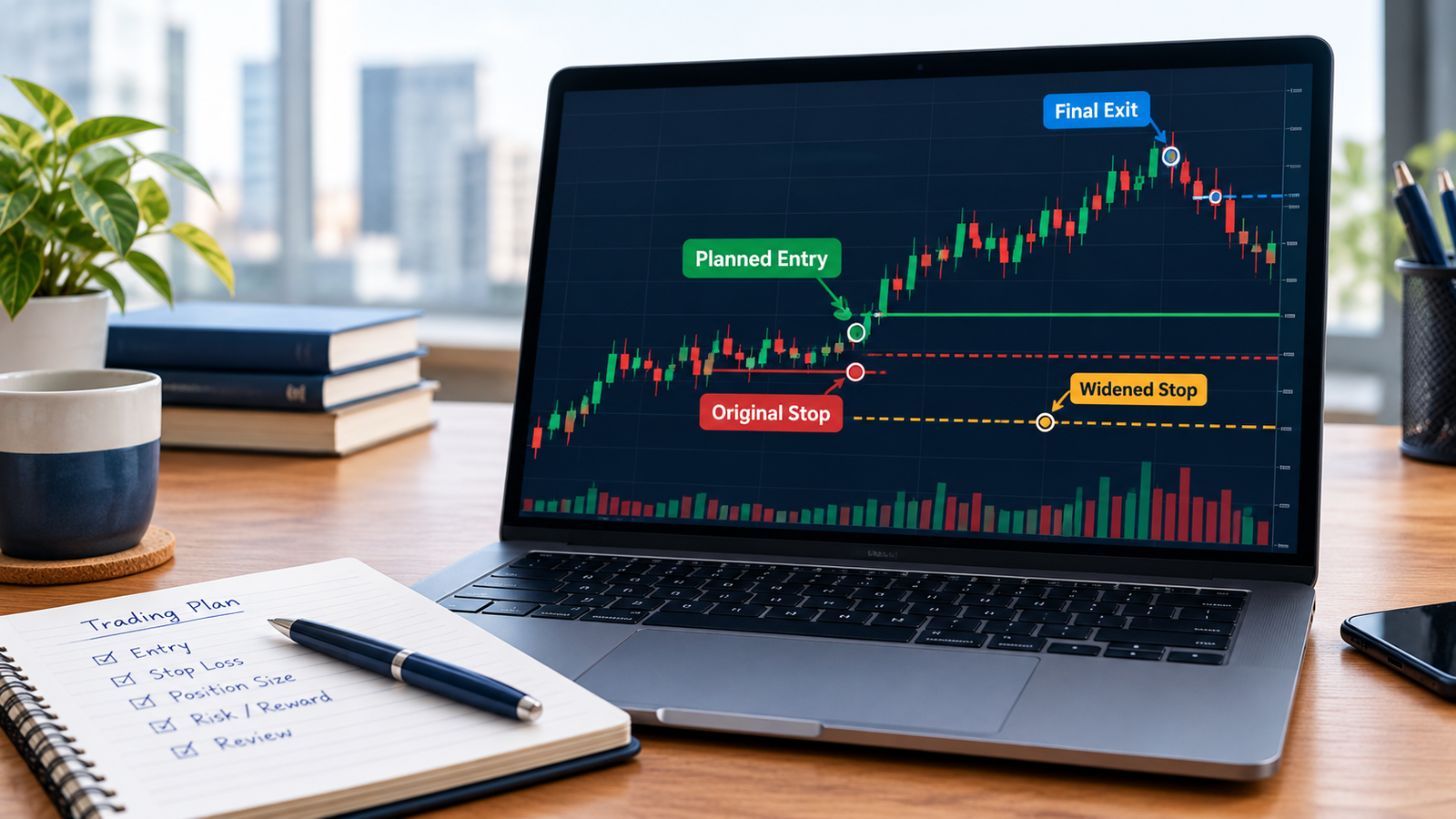
Table of Contents
What moving a stop-loss means
Moving a stop-loss means changing the level at which the trader planned to exit. The change can reduce risk, as with some trailing-stop rules, or increase risk when a protective stop is moved farther from the entry. This article focuses on the second case: widening a stop after price moves against the position.
Also Read: Trading Victory
Emotional stop widening occurs when a trader moves the exit farther from the entry to avoid realising a loss, without a predefined strategy rule or a new risk calculation. The decision increases exposure because the same quantity is now allowed to lose more per share or contract.
A stop trigger is not a guaranteed execution price. SEBI risk disclosures explain that a stop order activates when the chosen price is reached or crossed, after which it becomes the selected market or limit order. A stop-limit order may remain unexecuted if the market moves through its limit, while rapid movement, lower liquidity or technical problems can also affect execution. The risk plan must therefore allow for gaps and slippage rather than treating the trigger as a promise.
Also Read: Trendline
Why traders widen stops
Loss aversion
A realized loss feels final. Keeping the trade open preserves the possibility of recovery, even when the original setup has failed. Research on the disposition effect documents the broader tendency to realize gains while continuing to hold losing positions. It does not prove why any individual stop was moved, but it provides a useful behavioral lens for journal review.
Oversized positions
A technically reasonable stop can feel impossible to respect when quantity is too large. The trader then tries to solve a sizing problem by changing the chart level. Position size should be calculated after the invalidation level is identified, not the other way around.
Hindsight from previous reversals
A vague invalidation rule
If the stop was selected only because the rupee loss looked acceptable, the trader may have no clear reason to exit when price reaches it. A useful stop marks the point at which the trade idea no longer meets its original conditions.
The need to be right
Also Read: Top & Bottom Signals
How widening a stop changes rupee risk
Suppose a trader buys 100 shares at ₹250 and places the original stop at ₹245. The intended price risk is ₹5 per share, or ₹500 before charges and slippage.
| Item | Original plan | After widening |
|---|---|---|
| Entry | ₹250 | ₹250 |
| Stop-loss | ₹245 | ₹240 |
| Risk per share | ₹5 | ₹10 |
| Quantity | 100 shares | 100 shares |
| Intended price risk | ₹500 | ₹1,000 |
Moving a stop farther away increases planned rupee risk unless position size is reduced. New risk equals the distance from entry to the revised stop multiplied by quantity. The calculation still excludes brokerage, taxes, spread, slippage and gap risk, so the actual loss may be larger.
Also Read: Intraday Trading
Valid stop adjustment versus emotional widening
Not every stop change is a mistake. Some tested systems trail stops, respond to volatility or adjust after a structural change. The difference is whether the rule existed before the emotional pressure appeared and whether total risk remains within the plan.
| Question | Rule-based adjustment | Emotional widening |
|---|---|---|
| Reason | Defined strategy condition | Avoiding a realised loss |
| Timing | Rule written before entry | Decision made near the stop |
| Risk calculation | Recalculated and within limit | Often ignored |
| Direction | Usually reduces or deliberately controls risk | Increases allowed loss |
| Evidence | Tested across a sample | Justified by one trade |
| Documentation | Recorded in the plan and journal | Explained after the event |
Ask whether the same stop change would have been made if current P&L were hidden. If the answer depends on avoiding today’s loss, the change is probably emotional. Exit according to the existing rule, then review whether the strategy needs modification across a broader sample.
Also Read: Smart Money Concept
A stop-loss decision system
| Step | Action |
|---|---|
| 1 Define invalidation | Write the market condition or price structure that makes the trade idea invalid. |
| 2 Calculate distance | Measure entry to invalidation; do not squeeze the stop merely to buy more quantity. |
| 3 Size the position | Divide the intended rupee-risk budget by risk per share or unit, then check affordability and instrument rules. |
| 4 Choose the order | Understand the broker’s available stop-market or stop-limit mechanics and execution trade-offs. |
| 5 Write the change rule | Specify whether any trailing or volatility adjustment is allowed and when. |
| 6 Set the emergency rule | Define what happens if the order fails, gaps, or remains unexecuted. |
| 7 Review after exit | Judge the decision from the plan and available information, not from whether price later reversed. |
If price reaches my invalidation level and no predefined adjustment rule has triggered, then I will follow the planned exit. I will not widen the stop to avoid realising the loss. Any strategy change will be considered after the trade using a sample of comparable setups.
Also Read: Breakout
Pre trade stop-loss checklist
- ☐ I can explain what market condition invalidates the trade.
- ☐ The stop is based on the setup, not solely on a round percentage.
- ☐ Position size was calculated from the entry-to-stop distance.
- ☐ The planned rupee loss is acceptable without moving the stop.
- ☐ I understand whether the order becomes a market or limit order after triggering.
- ☐ I considered spread, liquidity, slippage and gap risk.
- ☐ Any trailing or adjustment rule is written before entry.
- ☐ I know what to do if the stop order does not execute as expected.
Also Read: Sector Rotation
If the planned loss feels too large, reduce quantity or skip the trade before entry. Do not make an oversized position emotionally tolerable by promising to use a stop that you are unlikely to respect.
Also Read: Momentum
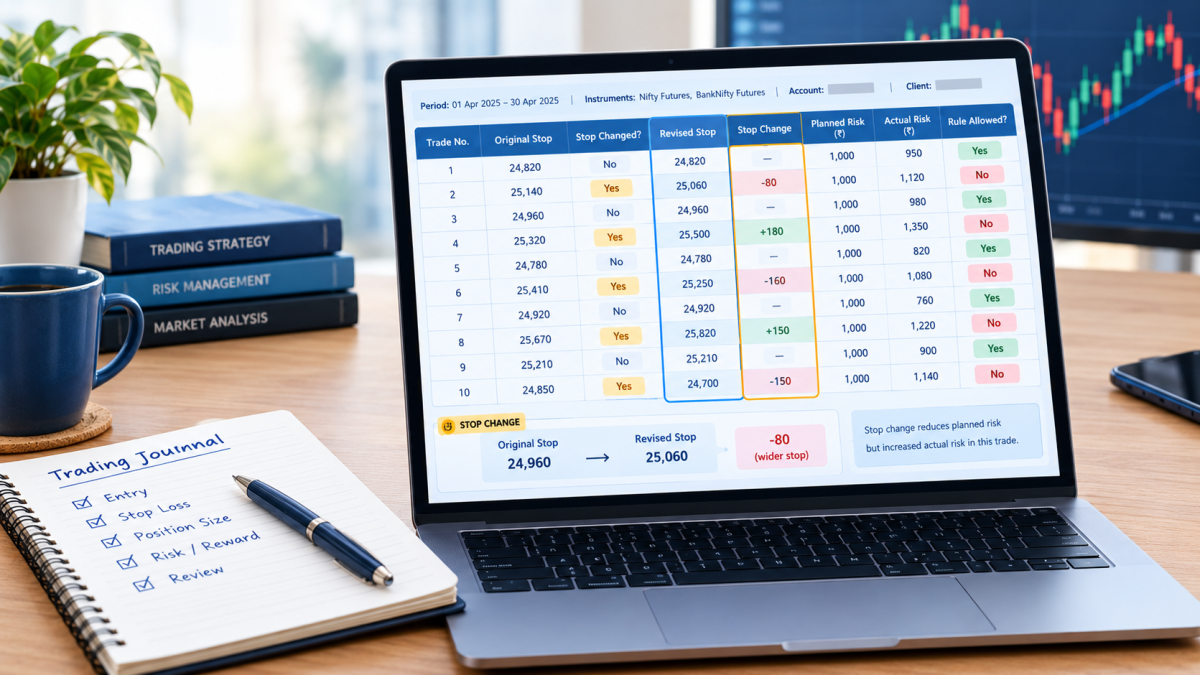
A journal audit for moved stops
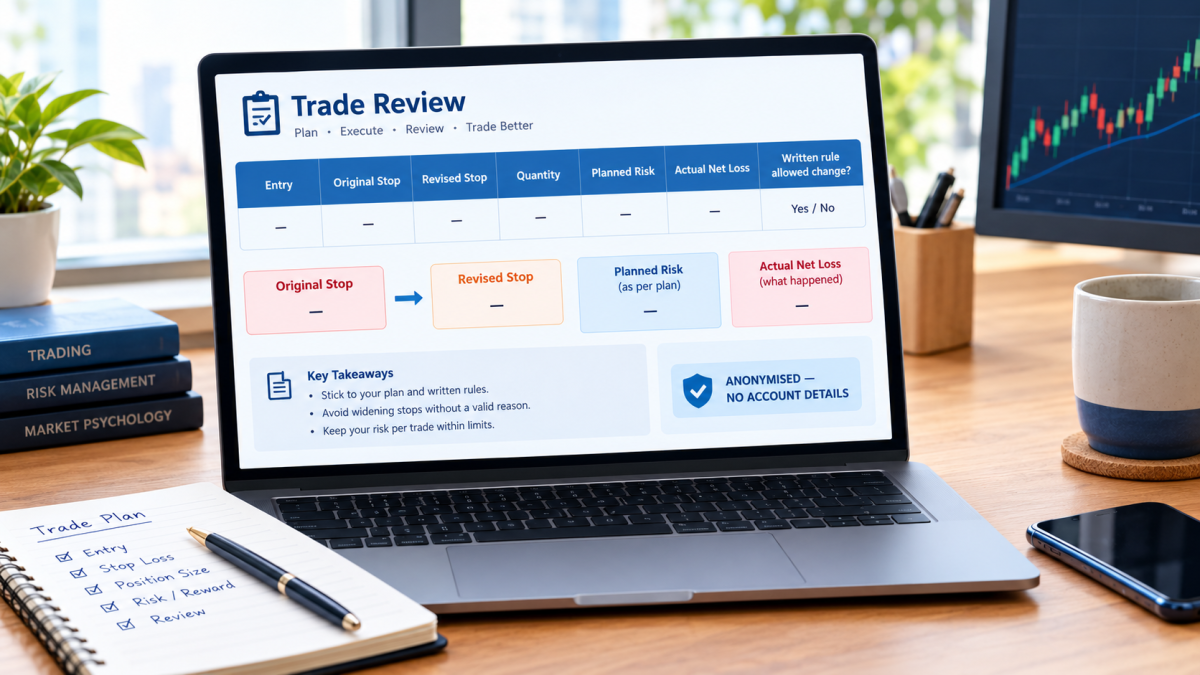
The journal should distinguish a planned stop, an order trigger, an execution price and a discretionary stop change. Combining them into one “exit” field hides the decision that needs review.
| Field | What to record |
|---|---|
| Original plan | Entry, invalidation, stop and quantity |
| Order mechanics | Order type, trigger and limit where applicable |
| Change | Time, old stop, new stop and stated reason |
| Risk impact | Original and revised rupee risk |
| Execution | Trigger time, fill price, slippage and charges |
| Rule status | Allowed adjustment or violation |
| After-trade evidence | Did the setup invalidate; did price later reverse; was that information available at the time? |
| Next action | Keep the rule, reduce size, clarify invalidation or test a change |
Also Read: Check Trading Journal
Metrics to calculate
- Stop adherence rate = Trades exited according to the planned rule ÷ Trades with a stop
- Widening rate = Unplanned stop widenings ÷ Trades
- Added planned risk = Revised risk – Original risk
- Execution gap = Actual exit price – Planned exit price, adjusted for trade direction
- Net cost of violations = Net result of moved-stop trades compared with their original planned exits
The final comparison requires consistent definitions and enough observations. A few reversals after a stop do not prove that the stop rule is poor, just as one large loss does not prove that every adjustment is wrong.
Also Read: Morning Star & Evening Star
A 10 trade discipline reset
For the next ten qualifying trades, use one objective: record whether the original stop rule was followed. Keep strategy selection and position sizing unchanged unless safety requires a reduction. This makes the behavioral test easier to interpret.
- Before each trade, write the invalidation sentence.
- Calculate quantity only after setting the stop.
- Save a chart screenshot at entry.
- Do not widen the stop unless the predefined adjustment rule applies.
- After exit, save another screenshot and record execution difference.
- Review all ten trades together; do not change the rule after one reversal.
If stop-related losses or trading behavior are causing serious financial or emotional harm, stop trading and seek appropriate professional support. A checklist is not a substitute for financial or mental-health care.
Also Read: Bollinger Band
Frequently asked questions
Why do traders move their stop-loss?
The common reasons include loss aversion, oversized positions, unclear invalidation, fear of being wrong and memories of previous stop-outs that later reversed.
Is it ever acceptable to move a stop-loss?
Yes, when a predefined and tested rule permits an adjustment and the revised exposure remains within the risk plan. Moving it farther solely to avoid a loss is a different decision.
Should a stop-loss ever be widened after entry?
A system may contain a documented volatility or structural adjustment, but discretionary widening increases risk and changes the original trade. Recalculate risk and follow only rules defined before the pressure arose.
Why did my stop trigger but the trade not exit?
A stop-limit order can trigger and remain unfilled if the market moves beyond its limit. Order availability and mechanics vary by broker and instrument. Review the order status and current broker documentation.
Can a stop-loss guarantee the maximum loss?
No. Gaps, slippage, insufficient liquidity, limit-order non-execution, technical issues and charges can make the realized loss different from the planned amount.
How can I build stop-loss discipline?
Use a clear invalidation rule, smaller risk-based size, a pre-placed order where appropriate, an if-then exit rule and a journal that measures every stop change.
Also Read: Golden Crossover
Key takeaways
- A stop should represent trade invalidation, not merely an emotionally comfortable number.
- Widening the stop with unchanged quantity increases planned rupee risk.
- Stop triggers and execution prices are different; gaps and non-execution remain possible.
- Reduce position size before entry when the planned loss feels difficult to accept.
- Allow adjustments only through rules defined before the trade.
- Measure stop adherence and added risk across a sample, not one outcome.
Also Read: Fibonacci Retracement
Educational disclaimer
This article is for educational purposes only and is not investment advice, a research report, a recommendation or an invitation to trade any security or derivative. Trading and investing involve risk, including the possible loss of capital. Examples are simplified and do not account for every cost, tax, liquidity condition, gap, order restriction or execution risk. Verify current broker and exchange rules and consult a SEBI-registered professional when appropriate.
Also Read: How to Identify False Breakout
Sources and further reading