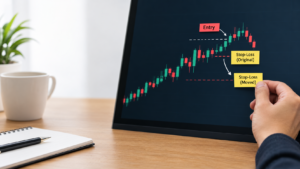

A trading loss does not need an immediate winning trade. It needs a correct diagnosis. First, stop placing new orders long enough to verify open positions, quantify the damage, and write down what happened. Then decide whether the loss was a normal outcome of a valid setup, an execution mistake, excessive risk, or an operational issue. Resume only when your entry, stop, size and daily-loss rules are clear again.
This approach cannot guarantee that the next trade will make money. Its purpose is narrower and more useful: to prevent one loss from changing the way you select and manage the next trade. You will also learn how drawdown recovery works, what to record in a post-loss review, and how to define a return condition that does not depend on feeling confident.
Quick answer: To recover after a trading loss, separate financial recovery from behavioural recovery. Financial recovery depends on future returns and cannot be forced. Behavioural recovery starts when you stop loss-chasing, verify your exposure, review whether the trade followed your rules, and return only under written risk limits. A break may help, but no fixed number of hours or days suits every trader or every loss.
Table of Contents
Key Takeaways
- Do not increase risk because the account is below its previous balance.
- Judge the losing trade by the quality of the decision, not only by the outcome.
- A larger drawdown needs a disproportionately larger percentage gain to recover.
- Use written return criteria instead of waiting for confidence to return by itself.
- Stop self-directed trading if the loss affects essential money or loss-chasing feels difficult to control.
Also Read: Trading Mistakes
What Should You Do Immediately After a Trading Loss
After a significant trading loss, stop new discretionary orders and confirm the facts before making another market decision. Check open positions, pending orders, margin obligations, realised and unrealised P&L, brokerage and statutory charges, and broker or exchange notifications. The immediate goal is to contain risk and obtain accurate information, not to earn the money back.
The word significant is personal. A ₹2,000 loss may be routine for one account and destabilizing for another. Compare the loss with the risk you had planned before entry, your daily loss limit, and the capital you can genuinely afford to expose. Do not define a loss as small merely because someone else trades a larger account.
A Simple First Response
- Cancel orders that are no longer part of a valid plan. Do not cancel a legitimate protective stop merely to avoid booking a loss.
- Verify whether any position remains open. Check quantity, product type, expiry, average price and available margin.
- Record the planned entry, actual entry, planned stop, actual exit, quantity, charges and slippage.
- Write one sentence explaining why you want to take the next trade. If the answer is to get back to breakeven, do not place it.
- Escalate broker or platform discrepancies through the broker’s official support and grievance process. Keep screenshots and reference numbers.
India context: SEBI’s investor material states that investors are responsible for their decisions and should understand product risk. Derivatives can create losses larger than the initial amount paid because of leverage and margin obligations. This is why exposure verification belongs at the start of the recovery process, especially in futures and options.
Also Read: Candlestick Trading
What Is Revenge Trading
Revenge trading means taking or changing a trade mainly to recover a recent loss rather than because a predefined setup is present. It may appear as a faster entry, larger position, wider or removed stop, or repeated trading after the daily risk limit. Taking the next valid setup after a loss is not automatically revenge trading; motive and rule adherence matter.
A practical test is to ask: Would I take this exact trade, with this size and stop, if the previous trade had been profitable? If the honest answer is no, the prior loss is influencing the decision. That does not prove the next trade will lose. It shows that your selection process has changed, which makes the result less useful for evaluating the strategy.
Common Warning Signs
| Observed change | What it may indicate | Safer response |
|---|---|---|
| Position size rises after a loss | The trader is trying to recover faster | Return to the prewritten risk cap; if no cap exists, stop and create one. |
| Entry happens before confirmation | Urgency has replaced setup quality | Save the chart and document the missing condition. |
| Stop is widened or removed | Booking another loss feels unacceptable | Use the original invalidation point or exit; do not redesign risk mid-trade. |
| More instruments are scanned | The trader is searching for any opportunity | Restrict the watchlist to the planned universe. |
| Breakeven becomes the session target | Past P&L is controlling the next decision | End the session or switch to review-only mode. |
Why Losses Can Distort the Next Decision
Prospect theory describes how decisions under risk can depend on gains and losses relative to a reference point. In plain language, a loss can make a person more willing to accept risk in an attempt to return to the previous level. This research explains a possible bias; it does not diagnose an individual trader or predict a specific trade.
Related evidence comes from Terrance Odean’s study of 10,000 brokerage accounts. The study documented a tendency to hold losing investments too long and sell winners too soon, commonly called the disposition effect. It concerned investor behavior rather than a universal rule for intraday trading, so it should be used as context, not as proof that every losing trader will behave the same way.
Also Read: Moving Average
How Should You Classify a Trading Loss
Classify a trading loss before changing the strategy. A losing outcome may be a valid planned loss, an execution error, a risk-limit breach, an operational problem, or evidence that requires a larger strategy review. Each category needs a different response. One result alone usually cannot prove that a strategy has stopped working.
| Loss category | Evidence to check | Appropriate response |
|---|---|---|
| Valid planned loss | Setup met written conditions; size and stop matched the plan | Record it as part of the strategy sample; do not redesign the method from one result |
| Execution error | Entry, exit, timing or order type differed from the plan | Identify the exact behaviour and add a control that prevents repetition |
| Risk breach | Quantity, leverage, stop distance or total exposure exceeded the limit | Stop live trading until risk rules and order controls are restored |
| Operational issue | Platform, connectivity, order rejection or data problem affected execution | Preserve evidence, contact the broker, and resolve the process before returning |
| Possible market-regime mismatch | A meaningful sample shows the setup behaves differently under current conditions | Test the hypothesis with data; do not infer it from one or two trades |
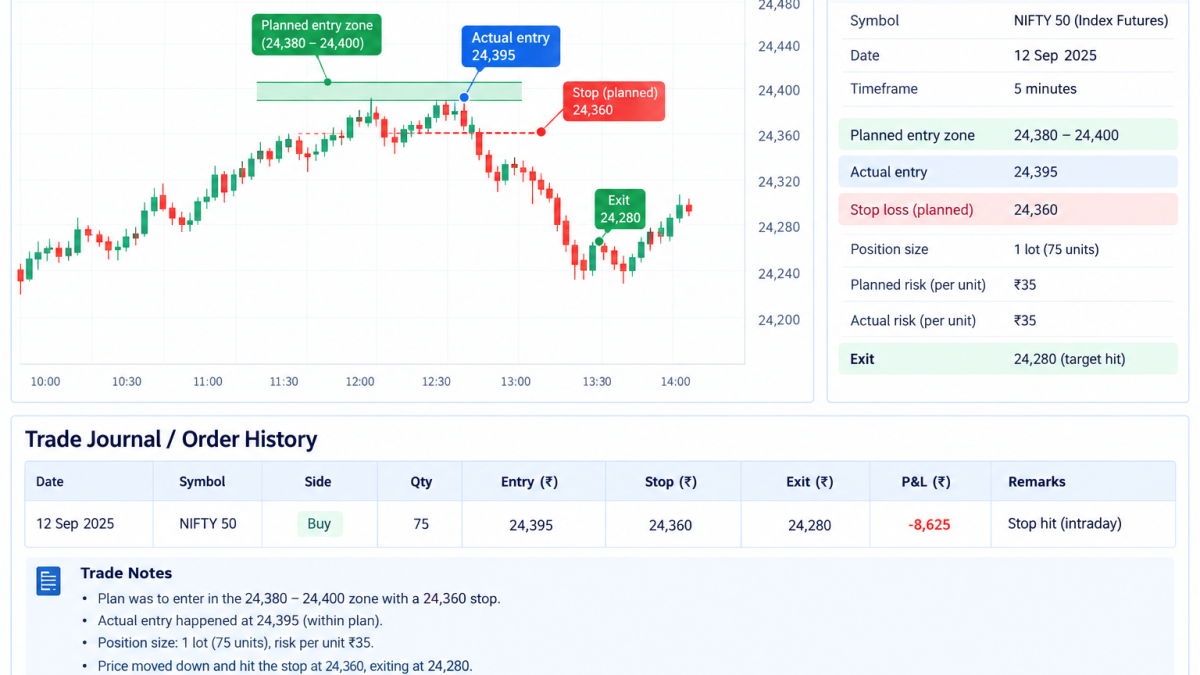
Author Observation: In my experience with the stock market, one lesson keeps coming back: a good trade starts with a clear plan, not a strong feeling. When a stock moves quickly, it is tempting to change your entry or ignore your original conditions. I have learned to pause and check whether the trade still meets my rules. If it does not, skipping the trade is a valid decision. Protecting your process matters more than participating in every market move.
How Much Return Is Needed to Recover a Drawdown
The percentage gain needed to recover a drawdown is greater than the percentage lost because the gain is calculated on a smaller capital base. The formula is required recovery = drawdown divided by one minus drawdown. Enter the drawdown as a decimal. For example, a 20% drawdown needs a 25% gain to return to the earlier account value, before costs and taxes.
Drawdown recovery formula: Required recovery = drawdown ÷ (1 − drawdown). Enter the drawdown as a decimal. A 20% drawdown requires a 25% gain to return to the earlier account value because the gain is calculated on the remaining 80% of capital. This calculation excludes brokerage, taxes, other charges and slippage.
Illustrative Example
If an account falls from ₹1,00,000 to ₹80,000, the drawdown is 20%. Returning to ₹1,00,000 requires a ₹20,000 gain on the remaining ₹80,000. ₹20,000 ÷ ₹80,000 = 25%. This does not mean the trader should target a quick 25% return; it shows why deeper drawdowns become progressively harder to recover.
| Account drawdown | Capital remaining from ₹1,00,000 | Gain needed to return to ₹1,00,000 |
|---|---|---|
| 5% | ₹95,000 | 5.26% |
| 10% | ₹90,000 | 11.11% |
| 20% | ₹80,000 | 25.00% |
| 30% | ₹70,000 | 42.86% |
| 50% | ₹50,000 | 100.00% |
Also Read: Trend Reversal
Why Increasing Size Does Not Repair the Mathematics
A larger position can produce a faster gain, but it also increases the rupee loss if the next trade fails. The market does not offer a higher-quality setup because your account is down. Position size should come from the planned stop distance and the risk amount the account can bear, not from the amount you want to recover.
Illustrative sizing check: If account capital is ₹80,000 and the prewritten risk limit is 0.5% per trade, the risk budget is ₹400. If the logical stop is ₹8 away from the entry, the theoretical quantity is 50 shares before allowing for slippage, gaps and costs. This is a sizing illustration, not a recommendation to use 0.5% risk or to trade that setup.
Also Read: Double Bottom
How Do You Review the Loss Without Rewriting History
Post Loss Review Template
| Field | What to record |
|---|---|
| Setup | Name the setup and list the conditions visible before entry |
| Plan | Planned entry, invalidation point, stop, target or exit rule, and maximum risk |
| Execution | Actual entry, exit, quantity, order type, slippage and charges |
| Rule adherence | Mark each relevant rule followed, missed or overridden |
| State | Record observable facts such as rushing, repeated order edits or inability to wait |
| Classification | Valid planned loss, execution error, risk breach, operational issue or data-review candidate |
| Single corrective action | Choose one control that directly addresses the error |
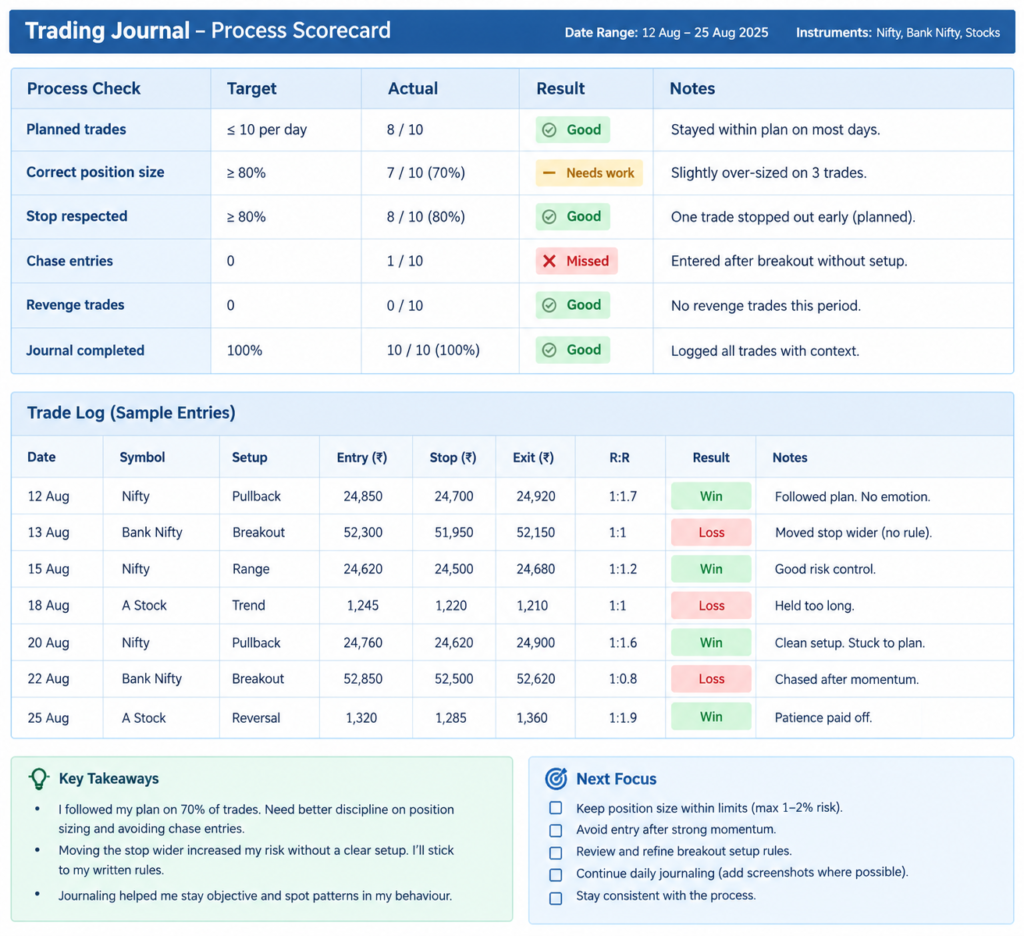
Author Observation: One thing I’ve noticed in my five years in the stock market is that the same mistake can show up in different forms. Sometimes I’d enter a trade in a hurry, and other times I’d move my stop because I didn’t want the trade to close at a loss. When I reviewed those trades later, I often found that I had ignored something I’d already decided before entering. It’s happened enough times that I now pay attention to whether I followed my original plan, not just how the trade ended.
Also Read: Triangle Chart Pattern
What Should Change After Different Types of Loss
After a valid planned loss, the main action may be accurate recording and no change at all. After an execution error, change the workflow that allowed the error. For example, add an order checklist if product type or quantity was wrong. After a risk breach, live trading should not resume merely because the trader feels calm; the exposure control must be restored and tested.
If the problem appears to be a strategy-market mismatch, define the market condition and test it across a meaningful sample. Avoid labels such as bad market unless you can state what changed: volatility, liquidity, trend persistence, gap frequency, spread, or another measurable variable relevant to the method.
Also Read: Sector Rotation
When Should You Trade Again After a Loss
Return to trading only when the loss is documented, open exposure and operational issues are resolved, the next setup can be judged independently of the previous P&L, and written risk limits are in place. Time away may help, but elapsed time alone does not establish readiness.
Also Read: Technical Analysis
Return to Trading Checklist
- All positions and pending orders have been verified.
- The loss has been classified using evidence.
- The next eligible setup is written in advance.
- Maximum position risk and daily loss limit are defined in rupees and percentages.
- Order quantity can be calculated from the stop distance without reference to the prior loss.
- No broker, platform, margin or data issue remains unresolved.
- The trader can accept another planned loss without changing size or removing the stop.
A temporary reduction in exposure may lower the financial consequence of another error, but there is no universally correct reduction. It must still respect lot size, liquidity, transaction costs and the trader’s tested method. If the minimum tradable size is already too large for the account’s risk limit, the correct answer may be no live trade.
Also Read: Trading Tick
How Can You Rebuild Trading Confidence
Rebuild trading confidence through process evidence, not by demanding a profitable next trade. Track whether the setup qualified, position size matched the risk calculation, the stop remained intact, and the review was completed. A well-executed planned loss can provide better evidence of discipline than a lucky rule-breaking win.
Paper trading or market replay may help test execution after a rule violation, although simulated fills and emotions differ from live trading. Use simulation to practice the process, not to claim that live performance has been restored. When returning to live trading, use only exposure that fits the written plan and your financial circumstances.
Also Read: Hedging
A Seven Session Process Scorecard
The following scorecard is an original decision framework, not a validated psychological test. Its purpose is to create observable evidence for a review. Do not treat seven sessions as a mandatory waiting period.
| Process item | Yes or no | Evidence |
|---|---|---|
| Only planned setups were considered | Watchlist and setup screenshot | |
| Quantity matched the risk calculation | Order worksheet | |
| No stop was widened after entry | Order modifications | |
| Daily loss limit was respected | Daily P&L and trade log | |
| Review was completed before the next session | Journal timestamp |
Also Read: Nifty Expiry
Also Read: How to Choose The Best Timeframe in Trading
When This Recovery Process May Not Be Enough
A self-directed trading reset is not enough when the loss involves borrowed money, emergency savings, missed obligations, concealed activity, repeated attempts to recover losses, or distress that affects sleep, work or relationships. Stop trading and seek appropriate financial and mental-health support. If you need personal investment advice, consult a SEBI-registered investment adviser and verify the registration on official SEBI resources.
This framework also cannot prove that a strategy has an edge. That requires clearly defined rules, sufficient data, realistic costs, and testing that avoids hindsight and selection bias. A clean journal can show whether you followed a plan; it cannot turn an untested plan into a profitable one.
Also Read: Breakout
Indian Market Risk Context
SEBI reported in September 2024 that 93% of individual traders in the equity F&O segment incurred losses over FY22 to FY24, with aggregate losses above ₹1.8 lakh crore. This statistic applies to the population and period studied; it does not predict an individual trader’s outcome. It does show why loss recovery advice should not encourage leverage, rapid position-size increases or guaranteed comeback claims.
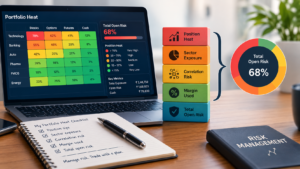
For a trader using derivatives, the recovery review should include expiry, lot size, liquidity, margin changes, gap risk and the possibility of losses exceeding the premium or initial margin, depending on the position. Verify current contract specifications and broker risk policies before publication or live use because these details can change.
Also Read: Chart Pattern
Common Mistakes After a Trading Loss
- Setting a deadline to recover the exact amount lost.
- Increasing size because a normal-sized winner would not reach breakeven.
- Changing strategy after one or two outcomes without a comparable sample.
- Calling a rule-breaking win evidence that the decision was correct.
- Ignoring brokerage, taxes, exchange charges and slippage in recovery calculations.
- Using confidence or fear as the only return-to-trading signal.
- Continuing because the loss feels too large to accept.
Also Read: Momentum
Frequently Asked Questions
Should I Stop Trading After One Loss?
One planned loss does not automatically require a trading break. Stop if the loss breached your risk limit, an operational problem remains, or you cannot evaluate the next setup independently. A trader may continue after a valid loss if the next setup qualifies and all risk rules remain intact, but the daily loss limit still applies.
How Long Should I Wait Before Trading Again?
There is no evidence-based waiting period that suits every trader. Wait until open risks are resolved, the loss review is complete, and your next decision no longer depends on recovering the previous P&L. After a risk breach or repeated loss-chasing, use stricter return criteria and consider professional support rather than relying on a timer.
Should I Reduce Position Size After a Losing Streak?
Reducing exposure may limit further damage while execution is being rebuilt, but the amount should come from account risk, stop distance, lot size and the tested method. A smaller trade is not automatically safe, and a fixed 50% reduction is not a universal rule. If minimum size exceeds the risk limit, do not trade live.
Can a Good Strategy Have Consecutive Losses?
Yes. A positive historical expectancy does not make every trade profitable, so consecutive losses can occur. Whether a particular streak is plausible depends on the strategy’s loss rate, independence assumptions, market conditions and sample quality. Do not assume normal variance or strategy failure without reviewing sufficient comparable trades.
How Do I Know If I Am Revenge Trading?
Also Read: Morning Star & Evening Star
Practical Recovery Checklist
- Verify positions, orders, margin and account balance.
- Stop new discretionary orders if urgency or loss-chasing is present.
- Record the planned and actual trade details.
- Classify the loss using evidence.
- Calculate the drawdown without converting it into a recovery target.
- Correct the specific process failure, if one occurred.
- Define the next eligible setup and risk limits in writing.
- Return only when the next decision is independent of the previous loss.
- Track rule adherence alongside P&L.
- Seek help and stop trading if essential money or wellbeing is at risk.
Also Read: Bollinger Band
Final Perspective
A loss becomes harder to manage when the account balance turns into a deadline. The market has no obligation to provide a recovery trade, and the next setup should not carry the burden of repairing the last result. Record the facts, identify the type of loss, restore the risk controls, and let future trades be judged on their own rules. That process cannot remove market risk, but it can stop one result from quietly rewriting the next decision.
Also Read: Nifty Reversal
Sources and Further Reading
- Securities and Exchange Board of India. Updated SEBI Study Reveals 93% of Individual Traders Incurred Losses in Equity F&O between FY22 and FY24. 23 September 2024. Direct source. Verified 8 October 2026.
- SEBI Investor. Understanding Derivatives. Current investor-education page. Direct source. Verified 8 October 2026.
- SEBI Investor. Dos and Donts of Investing in Securities Market. Current investor-education page. Direct source. Verified 8 October 2026.
- Kahneman and Tversky. Prospect Theory An Analysis of Decision under Risk. Econometrica 1979. Direct source. Verified 8 October 2026.
- Terrance Odean. Are Investors Reluctant to Realize Their Losses. The Journal of Finance October 1998. Direct source. Verified 8 October 2026.
Also Read: Fibonacci Retracement
Financial Disclaimer
This material is for educational purposes only and is not investment advice, a trading recommendation, or a promise of recovery. Securities market investments are subject to market risks. Derivatives and leveraged products can cause substantial losses. Conduct your own research and, when needed, consult a SEBI-registered professional. Examples are illustrative and exclude individual circumstances unless stated otherwise.
Also Read: False Breakout