Forex trading is the world’s largest financial market, with trillions of dollars changing hands every day. Yet many beginners jump in without a plan. As a result, they often lose money, not because the market is impossible, but because they start without the right foundation.
The good news is that you do not need to predict every market move. Instead, you need a clear process, sound habits, and realistic expectations. Once you understand the basics, you can make better decisions and improve your results over time.
Table of Contents
What Is Forex Trading?
Forex trading involves swapping one currency for another to benefit from price fluctuations. Traders study markets, control risk, and follow plans for better decisions. The purpose is to make gains from currency value movements. Forex trading is often referred to as FX or currency trading.
When EUR seems stronger than USD, you may enter a EUR/USD buy trade. If the price rises and you exit at the right time, you earn a profit.
Many traders choose forex because:
Also Read: Technical Analysis
For Beginners: Where Should You Start?
Many people focus on profits first. However, successful traders focus on learning first.
A practical beginner roadmap looks like this:
- Learn how currency pairs work
- Open a demo account
- Understand Risk Management
- Understand how leverage increases both profit and loss risk
- Practice using a Trading Journal
- Build a simple strategy
- Test it through Backtesting
- Validate it with Forward Testing
- Trade small when you go live
This approach helps you avoid many common Trading Mistakes.
Also Read: Options Trading
A Simple 30-Day Forex Trading Plan
Week 1
- Learn pips and lot sizes
- Understand currency pairs
- Learn market basics
Week 2
- Open a demo account
- Learn Market and Limit Order types
- Practice trade entries
Week 3
- Study Risk Management
- Learn Risk to Reward Ratio
- Start a Trading Journal
Week 4
- Practice Backtesting
- Try Forward Testing
- Place small live trades if ready
This gradual approach helps build confidence without risking too much money too early.
Also Read: Top & Bottom Signals
Also Read: How to Choose the Best Timeframe in Trading
How to Start Forex Trading in 7 Simple Steps
Forex trading can be started in seven simple steps:
- Learn how currency pairs work.
- Open a demo trading account.
- Understand basic risk management.
- Choose a regulated forex broker.
- Create a simple trading plan.
- Practice through paper trading.
- Start small with real money.
Most beginners skip one or more of these steps. As a result, they often lose money before gaining enough experience.
Also Read: Commodity Trading
Choosing a Forex Broker
Your broker has a major impact on your trading experience.
Before opening an account, check:
- Regulation and licensing
- Trading spreads
- Commission charges
- Deposit and withdrawal options
- Platform stability
- Customer support quality
A good broker cannot guarantee profits. However, a poor broker can create unnecessary problems.
Also Read: Gift Nifty
Costs Every Forex Trader Should Understand
Many beginners focus only on profits. However, trading costs matter too.
Common costs include:
- Spread
- Commission
- Slippage
- Overnight swap fees
- Currency conversion charges
- Withdrawal fees
Small costs may seem insignificant. Over hundreds of trades, however, they can affect overall performance.
Also Read: NiftyBees
How Forex Trading Really Works
Professional traders commonly rely on price action trading methods. Every trade has two parts: an entry and an exit.
You enter when you see an opportunity. You close the trade with either profit or loss.
Most traders use charts to make decisions. Some rely on Fundamental Analysis, while others focus on price action and Candlestick Trading. Liquidity and market structure play a key role in price movement.
Many also use tools such as:
These tools do not predict the future. Instead, they help you organize information and make better decisions.
If you want to study chart analysis in greater depth, you can also explore topics such as Candlestick Trading, Candlestick Psychology, Trendline analysis, Smart Money Concept, Order Block Trading, and Fibonacci Retracement techniques.
Also Read: Pledge
Also Read: Momentum
Your First Forex Trade in 5 Steps
Once your account is ready, placing a trade is straightforward.
- Choose a currency pair.
- Decide whether the price may rise or fall.
- Set your position size.
- Place a stop loss.
- Define your profit target before entering.
For example, if you expect EUR/USD to rise, you can enter a buy trade. If the price reaches your target, you earn a profit. If it reaches your stop loss, your loss stays controlled.
Also Read: MTF
Risk Management
If there is one skill that matters most, it is Risk Management.
Imagine you have a $1,000 account. If you risk 1% per trade, your maximum loss is only $10.
Now compare that with risking 10% per trade. Just a few losses could seriously damage your account.
Many experienced traders follow these principles:
- Risk only a small percentage per trade
- Use stop losses
- Maintain a healthy Risk to Reward Ratio
- Avoid emotional decisions
Good risk management is the foundation of long-term survival and consistency in trading.
Also Read: Hedging
Never Risk More Than 1% Per Trade
Suppose your account balance is $1,000.
- 1% risk = $10
- Stop loss = 50 pips
Your position size should be small enough that a 50-pip loss equals only $10.
If the trade wins with a 1:2 Risk to Reward Ratio:
- Risk = $10
- Potential profit = $20
This simple approach can protect your account during losing streaks.
Also Read: Golden Crossover
Strategies Beginners Can Understand
You do not need a complicated system.
Many successful traders use simple concepts, including:
- Breakout trading
- Double Bottom patterns
- Double Top patterns
- Triangle Chart Pattern
- Order Block Trading
- Smart Money Concept
The key is consistency. Many traders also use market structure analysis to identify trends.
A simple strategy that you follow well often beats a complex strategy that you constantly change.
Also Read: False Breakout
Also Read: Nifty Reversal
What Earnings Can Forex Trading Generate?
This is one of the most common questions. The honest answer is that results vary widely.
Forex trading does not generate fixed or guaranteed income, and profits vary based on market conditions and trader skill. Some beginners expect to double their account every month. Unfortunately, that mindset often leads to poor decisions.
A better goal is steady improvement.
Focus on:
- Protecting capital
- Following your rules
- Building consistency
- Managing risk
Over time, these habits can create better results than chasing quick profits. Many experienced traders focus on steady growth rather than huge gains.
For example:
- 2%–5% monthly growth is considered solid by many traders.
- 5%–10% monthly growth is often viewed as excellent.
- Professional traders usually prioritize consistency and risk control over aggressive returns.
Small gains compounded over time can produce meaningful long-term results.
Also Read: Circuit Limit
The Psychology Behind Better Trading Results
Most losses come from emotions rather than bad analysis.
Common psychological challenges include:
- Trading Fear
- Revenge Trading
- FOMO
- Overtrading
- Lack of patience
Think of trading like professional sports. Skill matters. However, discipline often determines who succeeds over the long run.
This is why trading psychology becomes extremely important in trading, and a trading journal helps identify emotional patterns like overtrading, revenge trading, and impulsive entries.
Also Read: Sector Rotation
Common Beginner Mistakes
Many traders struggle because of behavior rather than strategy.
Common mistakes include:
- Revenge Trading after losses
- Overtrading
- Fear of missing out (FOMO)
- Moving stop losses
- Risking too much on one trade
Recognizing these habits early can save both money and frustration.
Also Read: Demand & Supply
Also Read: Gold & Silver
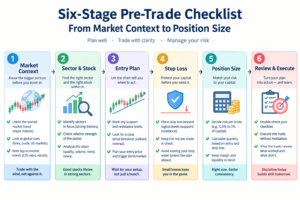
A Simple Forex Trading Checklist
Also Read: Crude Oil Trading
Forex Trading vs Other Markets
Forex is not the only market available. However, understanding how it compares with other markets can help you choose the right Trading Style for your goals and risk tolerance.
Market Comparison Overview
- Forex Market
Required Capital: Low to Medium
Risk Level: Moderate volatility
Trading Time: 24 hours, 5 days a week
Required Capital: Low
Risk Level: Low to Moderate volatility
Trading Time: Stock exchange hours only
- Commodities (Spot & Futures)
Required Capital: Medium
Risk Level: Moderate to High volatility
Trading Time: Extended trading sessions
Required Capital: Medium to High
Risk Level: High volatility
Trading Time: Extended hours
Required Capital: Low
Risk Level: Very High volatility
Trading Time: 24/7 (always open)
Each market has its own advantages. For example, Index funds may suit long-term investors, while Commodity Trading and Futures often attract active traders. Forex Trading remains popular because of its liquidity, accessibility, and nearly round-the-clock trading hours.
Also Read: Natural Gas Trading
Also Read: Copper Trading
What New Traders Often Learn the Hard Way
New traders often spend months trying to find the ideal indicator.
In reality, consistency usually matters more than finding a secret strategy.
Traders often improve faster when they focus on:
- Risk Management
- Trading Psychology
- Trading Consistency
- Following Trading Rules
- Reviewing a Trading Journal
The traders who survive tend to protect capital first and pursue profits second.
Also Read: Aluminium Trading
Frequently Asked Questions
Can I Start Forex Trading with $100?
Yes. Many brokers allow small deposits. However, focus on learning and risk control rather than quick profits.
Is Forex Trading Risky?
Yes. Every financial market carries risk. Proper Risk Management helps reduce unnecessary losses.
How Long Does it Take to Become Profitable?
Which Currency Pair is Best for Beginners?
Should I Use a Demo Account First?
Yes. A demo account allows you to practice without risking real money.
Is Forex Trading Gambling?
Forex trading becomes gambling when decisions are based on emotion or guesswork. However, traders who use a structured plan, risk management, and disciplined execution treat it as a skill-based activity rather than pure chance. Results depend on approach—undisciplined trading is gambling; structured trading is skill-based.
Also Read: Gold vs Silver
Before Opening Your First Trading Account
Also Read: Silver Trading
Final Thoughts
Forex trading rewards preparation more than prediction. Long-term success is not limited to the smartest traders alone. Instead, they are often the most disciplined. A structured trading plan is more important than any indicator.
Start small. Focus on learning. Keep a trading journal. Test your ideas through backtesting and forward testing. Most importantly, protect your capital while you build experience.
Better trading results rarely come from one perfect trade. They usually come from hundreds of smart decisions made over time.
Also Read: What is EGR