
Nifty expiry is the scheduled date when a Nifty 50 derivatives contract reaches its expiration. For Nifty 50 benchmark options, weekly contracts expire every Tuesday, while monthly contracts expire on the last Tuesday of the expiry month. When Tuesday falls on a market holiday, the expiry occurs on the preceding session. Nifty 50 futures reach expiration on the final Tuesday of each month.
For this guide, the main focus is Nifty 50 options expiry, because option premiums can change very quickly near expiry. Time decay, gamma, volatility, price movement, liquidity, and execution quality can all affect your trade. Therefore, you need a clear plan before taking an expiry trade.
Table of Contents
Nifty Expiry Day Checklist
Also Read: Demand & Supply
Before the Market Opens
Check these points first:
- Confirm the exact Nifty expiry date and contract.
- Check overnight global cues and the expected market gap.
- Mark major support and resistance levels.
- Note the previous day’s high and low.
- Review nearby ATM strikes and their option-chain data.
- Check major scheduled news or events.
- Set your maximum loss for the day.
Also Read: Short Selling Mistakes
After the Market Opens
Also Read: Fibonacci Retracement
Before You Enter
Also Read: Pledge
After You Exit
Record your entry, exit, strike, premium, slippage, reason, and result. Also note whether you followed your plan. This turns each expiry session into useful feedback instead of just a win-or-loss result.
Also Read: What Is Commodity Trading
Expiry Week vs Expiry Day
Expiry conditions change as Tuesday approaches.
- Before expiry: More time value remains, so premiums may respond differently.
- At the open, monitor initial price action, volatility levels, and nearby strikes.
- Midday: Time decay becomes more noticeable, especially when Nifty stays quiet.
- Final hours: Gamma sensitivity can increase around nearby strikes.
- Near the close: Avoid last-minute trades unless your strategy specifically covers this period.
Therefore, an expiry-week setup is not automatically the same as an expiry-day setup.
Also Read: Gold & Silver Trading
What Happens on Nifty Expiry Day?
Three key factors can strongly influence market behavior on expiry day.
First, time decay can become much more significant as the contract approaches expiry, especially for options with little intrinsic value. Therefore, options can lose value quickly when the index stays quiet.
Second, gamma tends to be highest near the money and can increase sharply as expiry approaches. As a result, small Nifty moves can cause faster changes in option delta and premium.
Third, traders adjust or close positions as expiry approaches. These factors may shift trading activity, OI, spreads, and price action near key strikes.
However, none of these effects guarantees a particular market direction. You should treat them as conditions, not predictions.
Also Read: How to Use Stock Heatmaps
IV and Time Decay Are Not the Same
Do not assume that every expiry session produces a dramatic IV crush. An option premium can fall because time value disappears rapidly, even when IV does not collapse sharply. The premium also responds to Nifty’s movement, strike, delta, gamma, and remaining time.
Therefore, separate two ideas:
IV decline = lower implied volatility.
Expiry decay = rapid loss of remaining time value.
Both can affect an option’s premium, but they affect it through different mechanisms. IV can also rise during a fast or uncertain market, which can partly offset or even outweigh time decay.
Also Read: How to Use TradingView
What Happens to Nifty Options at Expiry?
Nifty 50 market benchmark options are European-style contracts and are cash settled. Once trading ends, eligible ITM index options undergo exercise and cash settlement. No Nifty 50 shares are delivered. NSE states that final exercise settlement for index options is cash settled.
OTM options have no intrinsic value at expiry and generally expire worthless. An option whose final settlement value equals its strike also has no intrinsic value at expiry.
At expiry, a Call has intrinsic value when the final settlement value is above its strike, while a Put has intrinsic value when the final settlement value is below its strike. If the final settlement value equals the strike, the option has no intrinsic value.
Broker procedures for expiry positions can differ, so check your broker’s current rules. Brokerage firms may set different exit times, margin conditions, and position limits.
Review your broker’s latest expiry rules before keeping a position until settlement.
Also Read: ChatGPT vs Google in Trading
During the Trade
Once you enter, do not keep changing the plan because Nifty moves fast.
Watch:
- Whether price holds your key level
- Volume behind the move
- Changes in nearby Call and Put OI
- Bid-ask spread and execution quality
- Your predefined stop
- Your target or exit condition
If Nifty suddenly reverses, follow your invalidation rule. Keep your stop fixed instead of extending it to postpone a loss. During the final hour, reduce unnecessary entries and focus on your predefined exit rules.
Never chase the market after missing the original entry. If the original entry is gone, wait for a fresh setup.
Also Read: Sector Rotation
Expiry-Day Trading vs Holding Overnight
Trading an expiring option during the session is different from carrying it overnight into expiry.
An intraday trader can plan an entry and exit before the contract ends. An overnight position carried into expiry day is exposed to the next session’s opening gap, additional time decay, and the broker’s expiry-related rules.
Therefore, never assume you can carry an expiring position into the next session without checking the contract and broker policy.
Before carrying a position toward expiry, confirm:
- Settlement method
- Broker square-off policy
- Margin requirements
- Position restrictions
- Final exit time
A broker may square off an expiry-day position before the exchange’s normal market close, so never assume you can hold the position until the final trading minute.
For Nifty 50 index options, the settlement process is cash-based. Still, your broker may impose its own operational restrictions. Always check its current policy before expiry.
Also Read: ETFs
Nifty Expiry Schedule
| Contract | Expiry |
|---|---|
| Weekly Nifty options | Every Tuesday |
| Monthly Nifty options | Last Tuesday of the expiry month |
| If scheduled expiry is a trading holiday | Previous trading day |
2026 schedule note: NSE’s current contract specifications confirm Tuesday expiry for Nifty 50 weekly options and last-Tuesday expiry for monthly options. If the scheduled Tuesday is a trading holiday, expiry moves to the previous trading day. Always check the latest NSE expiry calendar before placing a trade because holiday schedules and exchange rules can change.
Also Read: Fundamental Analysis
Weekly vs Monthly Contracts
| Factor | Weekly Expiry | Monthly Expiry |
|---|---|---|
| Time remaining | Shorter-dated contract | Longer-dated than a comparable weekly contract |
| Time-value decay | Can accelerate sharply as expiry approaches | Can also accelerate sharply as expiry approaches |
| Premium sensitivity | Can become very high near expiry | Can also become very high near expiry |
| OI structure | OI may become concentrated around actively traded strikes, depending on market positioning | OI may be distributed across several actively traded strikes, depending on market positioning |
| Main challenge | Fast decay and gamma sensitivity | Longer exposure to events and price changes |
Also Read: Crude Oil Trading
Also Read: Natural Gas Trading
Why Nifty Expiry Can Move So Quickly
Expiry creates a unique mix of time pressure and price sensitivity. For example, suppose Nifty trades close to an ATM strike. A small index move can quickly change the option’s value. Meanwhile, the remaining time keeps shrinking. This creates a difficult environment for inexperienced traders.
Also Read: Trend Reversal
How Theta, Gamma, and Delta Affect Expiry Trades
Three Greeks deserve your attention:
| Greek | What It Means Near Expiry |
|---|---|
| Theta | Remaining time value may erode at a much faster rate |
| Gamma | Small Nifty movements can cause delta to shift rapidly |
| Delta | Indicates the option’s sensitivity to Nifty price movements |
For an option buyer, rapid theta decay can work against the position. For an option seller, that decay may help. However, the seller also faces potentially sharp losses when gamma causes delta to change quickly.
So, theta is not simply a “reward.” It is one part of the risk and return equation.
For example, Nifty may rise 50 points, but a Call option will not necessarily rise by 50 points.
Its premium is influenced by the Nifty’s price, strike, implied volatility, and time remaining. Delta and gamma describe how the premium can respond to changes in the underlying price.
An ATM option may react strongly to the same Nifty move. A far OTM option may react much less. Near expiry, gamma can also make the response change very quickly.
So, never estimate an option’s premium change or potential profit from the Nifty move alone.
Also Read: Morning Star & Evening Star
Why the Final Hour Can Become More Difficult
The final hour can become more challenging because time is running out and near-the-money options can become highly sensitive to small Nifty moves. Rapid price changes can also increase execution and slippage risk.
Therefore, avoid entering simply because “expiry is ending.” Trade only when your setup still offers defined risk.
Option Buyer vs Option Seller on Expiry
Expiry creates very different conditions for buyers and sellers.
| Factor | Option Buyer | Option Seller |
|---|---|---|
| Theta | Generally works against the buyer | Generally benefits the seller |
| Sharp move | Can produce substantial gains | Can result in significant losses |
| Main challenge | Getting direction and timing right | Managing risk during sudden price swings |
| Maximum loss | Typically restricted to the premium paid | Can be substantial; uncovered short calls carry theoretically unlimited loss |
Also Read: Order Block Trading
How to Read the Market Before Trading
Start with the broader market picture. Check the higher Timeframe first. Then mark important support and resistance zones. After that, study volume and open interest around major strikes.
You can also combine Price action trading with simple chart levels.
Look for:
- Strong support or resistance
- Clear momentum
- Fresh Breakout attempts
- Failed Breakouts
- Unusual volume
- Large open-interest changes
- A clean Entry and Exit plan
However, avoid adding indicators just because expiry feels complicated. A simple chart can often give you a clearer decision.
Also Read: Triangle Chart Pattern
How to Read the Nifty Option Chain
The option chain can show where traders have built positions. However, you should never treat one OI number as a prediction.
| Option-Chain Signal | What It May Suggest |
|---|---|
| Rising Call OI | More contracts are building at that strike. This can indicate potential resistance, but confirm with price action and premium behaviour. |
| Rising Put OI | More contracts are building at that strike. This can indicate potential support, but confirm with price action and premium behaviour. |
| Call OI Unwinding | Existing positions are reducing near that strike. Resistance could weaken, but price action should provide confirmation. |
| Put OI Unwinding | Existing positions are reducing near that strike. Support could weaken, but price action should provide confirmation. |
| Rising OI + Rising Option Premium | Both metrics are increasing. This may indicate fresh positioning, but neither measure reveals buyer or seller control alone. |
| Rising OI + Falling Option Premium | OI is growing while the premium declines. This may indicate new positioning, but direction cannot be determined from these metrics alone. |
Important: OI shows outstanding contracts, but it does not tell you by itself whether buyers or sellers are in control. Assess OI movements alongside premium changes, Nifty levels, volume, IV, and market structure.
Every open option contract has both a buyer and a seller, so rising OI alone does not reveal who has the stronger view.
For example, suppose Nifty approaches a major Call OI zone. If Nifty fails to cross that zone and Put OI declines, bearish pressure may strengthen.
However, OI can change for many reasons. Use price behavior, trading activity, liquidity and market structure to confirm the signal.
NSE’s option-chain data also displays volume, open interest, strike information, and reference IV. The exchange notes that displayed IV is dynamic and provided for reference.
Also Read: Technical Analysis
How to Use Max Pain
Max pain is an estimate based on the open-interest distribution across option strikes. It represents the strike where the aggregate theoretical payout to option holders would be lowest at expiry. It does not mean that traders or the market will necessarily push Nifty toward that strike.
You can use it as context, but not as a price target.
Suppose the estimated max-pain point falls close to 24,500. Nifty may trade around that level, but it can also move far away before expiry. Changes in open interest can also change the calculated max-pain level during the session.
Therefore, compare max pain with:
- Current Nifty price
- Major support and resistance
- Call and Put OI
- Volume
- Price action
- Market structure
A useful rule is simple: max pain can support your analysis, but it should never replace it.
Also Read: Candlestick Trading
Choosing the Right Strike
Strike selection deserves special attention. The first step is knowing where a strike sits relative to Nifty’s current price.
- ATM: The strike closest to the current Nifty price.
- ITM: A strike with intrinsic value based on the current index level.
- OTM: A strike without intrinsic value at that moment.
ATM options often show strong sensitivity to small Nifty moves near expiry. ITM options contain intrinsic value, while far OTM options can have very low premiums. Therefore, never choose a strike simply because its premium looks cheap.
Before choosing a Strike Price, ask:
- Does this strike match your market view?
- Is the contract liquid enough?
- Is the spread reasonable?
- Where will your trade become invalid?
- How much can you lose?
That last question should come before you calculate potential profit.
Also Read: Copper Trading
Also Read: Aluminium Trading
A Simple Nifty Expiry Trading Plan
You do not need a complicated system for every expiry.
Instead, create a short routine:
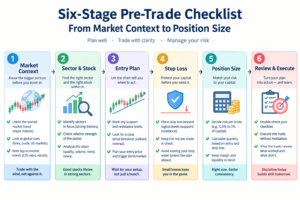
1: Check the market trend.
2: Mark major support and resistance.
3: Watch important ATM and nearby strikes.
4: Wait for your setup.
5: Define your stop-loss before entry.
6: Calculate position size from your risk.
7: Enter only when your conditions align.
8: Exit according to your original plan.
Your exit can follow one of these rules:
- Target-based: Exit when your planned target arrives.
- Stop-based: Exit when your trade thesis becomes invalid.
- Structure-based: Exit when price breaks the structure supporting your trade.
- Time-based: Close the position if it remains stagnant beyond your chosen timeframe.
- Partial exit: Book part of the position and manage the rest only if your rules allow it.
Never let a losing expiry position become a rushed bet near the close. If the setup fails, the trade is finished. This method encourages disciplined risk control and helps limit emotional choices.
For example, imagine Nifty breaks above resistance but quickly returns below it. Instead of chasing the first move, you can wait for confirmation. Waiting for confirmation may help you avoid entering a false breakout.
Also Read: 11 Crypto Insights
Two Simple Nifty Expiry Scenarios
Bearish scenario:
Nifty breaks below support and fails to reclaim it. Price action confirms weakness, while nearby Call OI remains elevated and price action continues to show rejection. You wait for confirmation before taking a bearish setup.
Range-bound scenario:
Nifty stays between major support and resistance. Breakouts fail repeatedly, and option premiums may lose time value as expiry approaches. If conditions remain unclear, waiting for a setup is perfectly reasonable.
These are examples, not guaranteed signals. You still need a defined stop, target, and position size.
Also Read: Gold vs Silver Trading
Nifty Expiry Risk Management Rules
Expiry trading can punish oversized positions very quickly. Prioritize preserving your trading capital before pursuing possible gains.
Use these simple rules:
- Set a maximum daily loss.
- Keep position size within your planned risk.
- Avoid revenge trades after a loss.
- Avoid taking larger positions simply because the option premium appears inexpensive.
- Respect your stop-loss.
- Avoid trades with poor liquidity.
- Reduce activity when your setup becomes unclear.
- Ensure combined position risk stays below your daily limit when holding several options.
Your Risk to Reward Ratio also deserves attention. Seek sufficient upside for the risk taken, but this ratio cannot ensure profitable results. Most importantly, never confuse a low premium with limited risk. An option can lose a large percentage of its value very quickly.
For example, assume you have a ₹3,00,000 account and allow a maximum risk of 0.5% on one trade. That gives you a maximum planned loss of ₹1,500.
Suppose an option costs ₹80 and your planned stop is ₹60. Your risk is ₹20 per unit.
Position size = Maximum allowed loss ÷ Risk per unit
If your maximum planned loss is ₹1,500, your theoretical maximum quantity would be: ₹1,500 ÷ ₹20 = 75 units
In live trading, actual loss can exceed the planned ₹1,500 because of slippage, brokerage, taxes, charges, and execution gaps.
However, you can only trade in the applicable contract lot size. Therefore, round the position size down to the number of lots that keeps your total planned loss within ₹1,500.
Always check the current NSE lot size before placing the trade because contract specifications can change.
Also Read: How to Analyze Heikin Ashi Candle
Nifty Expiry Trading Costs and Slippage
The amount earned before costs differs from your final take-home profit.
Expiry trading can involve:
- Brokerage
- Exchange transaction charges
- STT
- GST
- Stamp duty
- SEBI charges
- Bid-ask spread
- Slippage
For example, you expect to buy an option at ₹100 but receive a fill at ₹103. Later, you expect to sell at ₹110 but receive ₹107. Your expected ₹10 gain becomes only ₹4 before other costs.
The way you execute the trade matters as much as your setup.
Also Read: Bollinger Band
Watch for Liquidity Traps
A low-priced option can still be difficult to trade.
Check:
- Bid-ask spread
- Recent volume
- Open interest
- Order-book depth
- Expected slippage
- Distance from the ATM strike
A contract can show high volume yet still become difficult to exit during a fast move. Check the live bid-ask gap and likely fill quality before entering the trade.
Also Read: Candlestick Psychology
Nifty Expiry and Trading Psychology
Your mindset matters even more when prices move rapidly. Expiry can create excitement, fear, greed, and FOMO within minutes. That emotional pressure can lead to Revenge Trading or repeated entries.
Instead, follow your Trading Rules, if:
Your setup is missing, stay out.
Your stop-loss triggers, accept the loss.
The market moves without you, let it go.
There is no need to trade every market movement.
A short Trading Journal can also help. Record your entry, exit, reason, risk, and mistake after each session.
Over time, this can improve your Trading Consistency.
After each expiry session, record:
- Market direction
- Setup used
- Strike and premium
- Entry and exit
- Planned stop and target
- Actual slippage
- Trading costs
- Profit or loss
- Reason for entry
- Reason for exit
- Emotional state
- One mistake
- One lesson
This helps you separate a good decision from a lucky result.
Also Read: Why Silver Is in Demand
Also Read: EGR
When Should You Avoid Nifty Expiry Trades?
Sometimes the best trade is no trade. You should also distinguish between avoiding an option-buying setup and avoiding an option-selling setup.
Avoid buying when:
- Move already looks exhausted.
- Option has very little time value left and your strategy does not specifically account for that condition.
- Spread is too wide.
- You have no clear directional trigger.
- You are entering only because the premium looks cheap.
Avoid selling when:
- You cannot define your maximum risk.
- A sharp breakout is developing.
- Liquidity is poor.
- You lack enough margin or protection.
- You are selling only because premiums look expensive.
The right decision can be to wait for better conditions.
Consider staying away when:
- You feel tired or distracted.
- Your internet connection becomes unstable.
- Spreads become unusually wide.
- A major news event is approaching.
- Your strategy gives no valid signal.
- Your predetermined maximum loss for the day has already been reached.
- You feel tempted to recover a previous loss.
You can also use Paper Trading before risking real money. Backtesting and Forward Testing can help you understand whether your setup works across different market conditions.
Also Read: Circuit Limit
Test the Strategy Before Using Real Money
Do not judge an expiry strategy from one winning session.
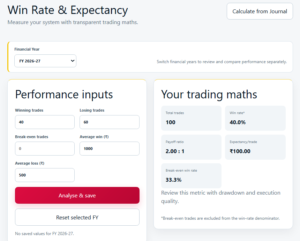
Track enough trades to measure its expectancy:
Expectancy = (Win Rate × Average Win) − (Loss Rate × Average Loss)
A strategy may win frequently yet lose overall when its losses greatly exceed gains.
Use Backtesting, then Paper Trading, and finally Forward Testing with small, controlled risk. Past results cannot guarantee future performance. However, testing can show whether you can follow the strategy consistently.
Also Read: Gold Trading
Common Nifty Expiry Myths
| Myth | Reality |
|---|---|
| Option selling is always safer | Sellers can face steep losses during sudden market moves, especially without hedges or strong risk controls. |
| High volume guarantees easy execution | Actual execution still depends on spreads, liquidity, and current market conditions. |
| Every expiry produces a huge move | Nifty can also remain within a defined range during expiry. |
| Max pain predicts the closing price | Max pain reflects option positioning; it cannot guarantee the closing level. |
| A cheap option has low risk | A low-priced option can still lose most of its premium rapidly. |
Likewise, do not assume that every expiry day needs an aggressive strategy. Your Trading Style should match your experience, risk tolerance, and process.
Also Read: MCX
Also Read: Futures & Options
Frequently Asked Questions
What is Nifty Expiry?
Nifty expiry refers to the scheduled date when a derivatives contract terminates. Nifty 50 weekly options currently expire every Tuesday.
When Does Nifty Weekly Expiry Occur?
Weekly Nifty 50 options currently reach settlement each Tuesday. If Tuesday is a trading holiday, expiry shifts to the previous trading day.
Are Cheap Nifty Options Safer?
No. Low-priced options can still face steep percentage losses and accelerated time decay.
Is Nifty Expiry Suitable for Beginners?
Expiry trading can be challenging because premiums may change rapidly. Beginners should first understand options, practice with Paper Trading, and use defined risk.
Can Nifty Expiry Dates Change?
Can Max Pain Reliably Predict Where Nifty Will Finish on Expiry?
No. Max pain is an estimate based on option positions. It should not replace price action, market structure, or risk management.
Why Can a Nifty Option Lose Value Even When Nifty Barely Moves?
Time value can fall rapidly near expiry. Therefore, an option can lose premium even when the underlying index remains relatively stable.
Also Read: Leverage
Your Nifty Expiry Decision Flow
Before entering a trade, ask:
Is today the correct expiry?
↓
What is Nifty’s current market structure?
↓
Where are major support and resistance levels?
↓
What do nearby Call and Put OI show?
↓
Is volume supporting the move?
↓
Is the option liquid enough?
↓
Where is the entry trigger?
↓
Where is the trade invalidated?
↓
What is the target?
↓
How much can you lose?
↓
Do costs and slippage still make the trade worthwhile?
If the answers are unclear, waiting is a valid decision.
Also Read: Bullion
Final Thoughts
Nifty expiry does not become easier simply because you act quickly.
Instead, you need preparation, patience, and controlled risk. Check the market structure, option chain, liquidity, and your setup before entering.
Then define your entry, invalidation, target, position size, and exit before the trade begins.
When conditions lack clarity, choosing not to trade can be the wiser decision.
Your goal is not to capture every expiry-day move. Your goal is to protect your capital while making better decisions over time.
Disclaimer: This content is for educational purposes only and should not be treated as financial or investment advice. Derivatives trading involves substantial risk of loss. Always verify current NSE contract specifications, expiry dates, and your broker’s policies before trading.
Also Read: Confluence